BS"D
Erev Shabbat Parsha Shelach Lecha 5770
June 3. 2010
Last week we asked you to spy out the Land and return with a good report. (here's that post) I am happy to say the vote this time is united: The Land is indeed very, very good! You can still send us the results of your intelligence; we'll be happy to include it.
Now...for the Spies' Report:
When I think of Israel, I am reminded of so many friends who had the courage to pick up everything and leave the familiar surrounding of America and go home to a place that really feels like home...The common thread all these friends share, aside from living in Israel, is that they are content. When [one dear friend] moved, she was 100% confident that she would love her home - not just her house, but her home. When I speak with her now, she agrees that she is content. There is no other place she'd rather be.
I echo the sentiments of those who feel a connection to the earth of the Eretz. It is holy dirt, earth that our ancestors trod, dust that covers my shoes covered their shoes. The pride and unconditional love I feel for the land comes from knowing I carry on a tradition handed down from HaKadosh Baruch Hu to us, his children, to visit historical places in Jewish history, unearth Jewish antiquities and preserve them and keep His Torah alive. You cannot do all this anywhere else but Israel.
Here's my 12 reasons to love Israel:
1. What a pleasure it is to be majority religion.
2. What a pleasure it is for things to close down Friday afternoon and reopen Sunday morning, not Sunday at 12.
3. What a pleasure for place of business to be open Christmas day and be closed on Rosh Hashana.
4. What a pleasure it is be able to eat in any restaurant because the food is kosher.
5. What a pleasure it is to find so many hat shops!
6. What a pleasure it is to find modest clothing in women's clothing stores.
7. What a pleasure it is to be able to find a small shteibel on virtually every corner.
8. What a pleasure it is to see all walks of women (orthodox and non-orthodox) using the same mikvah.
9. What a pleasure it is to touch the smooth stones of the Kotel, knowing the tens of thousands of fingers have touched them for the same reasons you touch them - to get a millimeter closer to HaShem.
10. What a pleasure it is to feel so safe and protected in a place where many would argue is extremely unsafe.
11. What a pleasure it is to hear your neighbors singing the same Shabbos songs you're singing, every single week.
12. What pleasure I take in knowing that one day, Please G-d, I, too, will be able to live in Israel.
Love,
Pam
----
What a wonderful thought. Here is my list.
1) I find inner peace when I am in Israel and it gives me strength to
return to my life here in Canada to enjoy my friends and family.
2) I now have relatives living in Israel.
Regards
Marsha Krakowsky
---
I loved feeling that, no matter where I went in Israel, I felt I belonged, that I was home.
Judy
---
Hi, what a great idea! I can think of lots of things I loved about being in Israel. . .
I loved feeling like every minute I was accomplishing something, just because I was in Israel. If I rode the bus, it was major, just because I was in Israel. If I went to the grocery store, it was a big deal, just because I was in Israel. Nothing I could do felt like a waste of time.
And, of course I loved the sharing of taxis. Two people standing somewhere, maybe you were going in the same direction? From taxi rides, I received Shabbos invites and made new friends. I tried this in New York once. . . just didn’t' have the same feel.
Oh yes, and even the most secular of Israelis believes in G-d. “Baruch Hashem,” you hear people saying. Here, in America, it often feels like we intellectually believe in G-d, but we don't really. We don't feel it. We just rationalized it/justified it/logic-ed it out. But there -- you FEEL G-d.
There is a sense that we are all one big family, that G-d is with us, and there is meaning to every minute of our lives. Not a day passes that I don't think of moving back. . .
---
-Every family needs a home, and living in Eretz Yisroel is living in our family's true home.
-Every few steps we walk we are fulfilling the Mitzvah of Sechar Halicha
-Being around other Jews, you always have someone to learn from
-The history of our people is around every corner here
-The land is beautiful and Jerusalem in particular is Yafefiah - very beautiful.
---
Walking through the Machane Yehuda shuk you have a plethora of delicious fruits and vegetables, most were grown keeping laws of Truma, Maaser, Orlah, and Shmittah, that can only be done here!!!
On Shavuos, regardless of cultural differences, 100's of 1000's of Jews gather at the Kotel, where Hashem's Shechina is most revealed, and daven together.
When you donate blood here, you are giving directly to your brother.
The bus driver says, "Shalom."
You can buy food for years at the local grocery without having to pay your bill; isn't that a ridiculously high level of trust?
When you take a loan from the bank, they provide the Heter Iska! (a halachic contract for business transaction between lender and debtor)
There are no cars on the highway on Yom Kippur, so the very secular make bike races on that day - because even they won't drive a car on Yom Kippur!
---
From Faith Cohen
I always say that my role as madrica on these Birthright trips is just a facilitator. The real tour guide is the Almighty— and the land really inspires, captivates and leads the group. My job is to bring them safely to different locations, and let the majesty of the land and the kedusha of the air take over.
1. A silent night stroll in the desert under the stars creates a noise that is as loud as thunder when it reverberates with the soul. During the "Bedouin Experience" portion of the trips, we take the group for a quiet walk through the desert. It is on these walks and afterwards through reflection that participants realize that they are an integral part of the Jewish people. They look at the numerous stars in the sky, and learn that they too are a link and a part of the promise given to Avraham Avinu. Perhaps they would feel this anywhere in the world when faced with a sky lit up as bright as day with hundreds of sparkling stars, but when paired with the experience of meeting our homeland and learning about our heritage, and tracing the footsteps of our ancestors, they are awoken in a way that is indescribable.
2. Meeting a soldier who is your age, and realizing that you have more in common than you thought. "Mifgashim" is a part of the Birthright trips— where soldiers come to join the group as participants. Often, the American participants think they'll have nothing in common with the soldiers. That is until they meet them and realize that these soldiers are their age, their peer group, and support the weight of the state of Israel on their shoulders. The amount of love and support shown to the soldiers by the end of the trip is awesome. They become a part of the group, and the participants can really see and feel that these individuals are sacrificing not just for Jews in Israel, but for all of klal yisroel.
3. Seeing the Kotel for the first time, and crying even through you don't know why. There is something about Yerushalyim, and the Kotel in particular that really strikes a chord inside someone's soul. When I see those tears, I know that it is coming from deep within them— and something subconsciously draws them to the wall. There really is no other way to describe it. Ultimately, their neshamos are a part of something much larger, and just that atmosphere of kedusha at the Kotel brings them back to that realization.
---
I miss "crying" as an acceptable social activity. If you go to Kotel, kever Rachel, any of the graves of tzadikim, it's perfectly acceptable -- praiseworthy -- to cry out in pain, anguish, need of a refuah! In America, life must always be perfect -- "have a nice day" is a platitude that no one really means, and if anyone asks, "how are you" they really don't care. If I wanted hang out with a girlfriend and of these locales, where we would inevitably end up crying, would be an activity. A meaningful, worthwhile activity.
And, I miss feeling like you can get on a bus, and know "generally' where you're going, with full faith that someone on the bus will help you find exactly where you need to be. And where hitchhiking is an acceptable -- and safe -- form of transportation.
And of course the Kotel. Not just for the crying. But the feeling like there really is a center of the universe.
The positive aspects of this land are to numerous to even try to list. The sky is bluer, the air fresher, sweeter, the food tastier the people more real and alive. The day-to-day existence is so filled with reality that one comes to understand what is real and meaningful, and it’s not what you'd expect.
---
1. To be able to daven at the Kosel
2. To be among our own people, everywhere i.e. shopping, buses, just walking around
3. The siren on Erev Shabbos- no cars on Shabbos in the old city
4. To be able to daven at so many mekomos hakedoshim
5. To be in the land Hashem promised us
---
I never lived in Israel, but have dreamed about it since my 1st visit in 1968. My second visit was in 1988 and I felt my heart sink seeing the Old City for the first time in 20 years, realizing I wasn’t a part of the rebuilding by living there. So, in my 8 subsequent visits, I’ve only imagined what it would be like to live every day in Eretz Yisrael.
Here’s what I think the best part of living in Israel would be: I would feel a sense of gratitude every day for where I live instead of a deep seated longing that goes unfulfilled. I would breathe the holy air of the holy land every day. Remember that Hashem made each of us in His holy Image to choose wisely what we do with our lives and where we spend our time.
That’s my 2 cents for today.
Judi Kirk
---
The best for me is that everyone is Jewish and you don't feel different. Although my relatives there are 2nd and 3rd cousins, they feel much closer. We feel like one of them. Once I was very sick in Israel and wound up in the old hospital in Safed. Although scared, I felt that I was in good hands. When my doctor came in with a Kippah, I felt safe and it would be okay. The best is that feeling of being home.
---
Thanks for the invitation to contribute. Some things quickly came to mind. You should not attribute me: I do not wish to blow my cover since I may wish to spy for you in the future, too.
1) Living as an observant Jew in a pastoral setting (small town, village, farming community)
2) Being able to observe shmitta in all its manifestations
3) Living among Jews of all stripes and flavors, within a generation or two of arrival from >100 countries
4) Walking where my ancestors walked thousands of years ago
5) That radio program discussing this week's haftora, immediately following a pop hit by Lady GaGa... and targeted the same audience
6) The group (somewhat immodestly dressed) teens in a food court during Pesach, squinting as they read a ketchup package to see if it contained chometz
7) Not having to explain why you feel as you do....
8) Is it reishit tzmichat geulateinu (the first flowering of our Redemption) or not? Even if we do not know, living in Israel surely can’t hurt...
---
I've only been to Israel twice in my life: once when I was 18 with my parents and siblings, and right before I met my bashert; and the other time with my bashert and our four sons. I was conservative observant at age 18, and more orthodox observant when I went to Israel the second time. Both times, I had the same feelings when we arrived in Israel and when we left Israel. I was overcome with joy of returning home, and overcome with sadness of leaving Israel, our true home. A friend of ours calls Israel the "heart of the world.” It tears at our heartstrings when we are away from it.
Pam Williams
---
Thank you for this wonderful challenge - wonderful to think about all the things I love about living in Israel; challenging, because I have to pick and choose the one(s) most appropriate for this project. Feel free to visit my blog and take anything you like out of there. Here's my attempt at summing it all up:
Living in Israel means living MY calendar. My holidays are the country's holidays. My days off from work are my employer's days off from work, etc. This weekend is Memorial Day here in the U.S. It means little more to me than a bar-b-q. Ditto for Independence Day (July 4). New Year's Day (January 1) is when I start dating my checks with a new digit or two at the end. In Israel, I cry on Memorial Day, jump for joy on Independence Day and on Rosh Hashanah I stand before the King of Kings "ba'Makome asher yivchar" (in the place that He has chosen). Take me Home!
Yashar Koach on throwing the ball in our court, Rena. Can't wait to see what you compile.
Love, S.
http://www.rememberjerusalem.blogspot.com/
---
SO here are 12 things I love
1-The children are very self reliant on the one hand, and maintain their childishness too
2-The school and work calendar is built around the Jewish calendar -- no need to take vacation days for chaggim
3-Fresh bread is dropped off outside the local store in the morning, if the store is not yet open; I can take a loaf of bread and pay for it later
4-We are all family -- a deliveryman can yell you at one moment and be giving you brachot the next
5-Buying tzitzit and bedikat cloths at the grocery store
6-On erev Shabbat and erev Chag, the streets are lined with vendors selling flowers and fruit for Shabbat
7-The grocery clerks wishes you a Shabbat shalom and chag sameach
8-The tent in the parking lot sells Purim costumes
9-The pool has separate hours for men and women
10-It's more common to find big families in small homes than small families in big homes
11-Yom Hazikaron is truly a day to remember those that paid the ultimate sacrifice for this land
12-You can travel a short distance and be in a place relevant to Tanach
c
---
For us, now being back in America, we can see that during our time in Israel, although there were the gashmius "difficulties" and "adjustments" the spiritual clarity and day-to-day ruchnius was ever-present.
Of course now in America, and worldwide, most people are experiencing the gashmius "difficulties" and "adjustments" AND are TOTALLY lacking spiritual clarity and daily, or even monthly, ruchnius. So I guess that makes a very strong case for where we need to be...
Jennifer
---
Shopping in Machane Yehuda Thursday nights and Friday mornings to
prepare for Shabbos. it is great fun buying rugelach, salads, and
cheeses with thousands of other Jews, while eating a falafel and
shlepping all of your bags.
Celebrating Purim all week long. The stores are all loaded with silly
costumes, and shaloch manos baskets galore. The streets are filled with
happy children dressed up in costumes singing age-old Purim songs. the
joy lasts for days even when the parade is over.
Living in the old city and celebrating Yom Yerushalim with loads of other Jews while listening to a concert and watching fireworks.
Going cherry picking on a local kibbutz and being able to learn how to take your own truma and maaser on your fresh picked cherries.
Staying up all night on Shavuos hopping from one class to another, or one cheesecake party to another and meeting thousands of other Jews down at the Kotel for sunrise Shacharis.
Watching the yeshiva HaKotel boys dance and sing their way down to the Kotel for Kabbalat Shabbat.
This is a small sampling from josh and Jodi
---
& here's a final note from an insightful woman in America who, like many of you, is strengthening K'lal Yisrael in her own special way:
Things could change. At this time in our life, I feel we will be better off here (we are very blessed in so many ways).
As I walk in the neighborhood I say Berachas for all the people I see and all the homes we pass. Does I help them? I do not know but it helps me.
We are grateful you and David are happy living there and my constant prayer is for a political change, for a better world absorbed in study of Torah.
---
Well, I am crying, how about you??
Reading your reports really made me think about what it will take for everyone to see how amazingly good the Land is. Besides seeing the good and speak positively, I wonder... if we are also being negative (sad, complaining, jealous), are we dulling the good we've put out there? For example, I just don't understand when I hear my fellow olim say, "It's too hot to...(fill in the blank)," "I can't find decent mustard (...soy sauce, dry cleaners...) anywhere in this country," or " What's with all the sick cats?"
The sin of the spies was one of Loshen Hara, hearing and believing slander, true or not. We correct that damaging trait with an "ayin tova" focusing on the good in The Land of Israel.
B"H it's hot, that means fields and fields of sunflowers! The mustard is just fine here, maybe having 17 choices is not so important, anyway. And remember, you can now find decent tunafish and Heinz ketchup pretty much about anywhere. About the cats...we have virtually no rats, case closed.
And it's not only the Land, as our final spy reported. It's even more important, I think, when it comes to each other. Let's not talk about "them" : the groups of Jews we don't "get.” Let's not be distracted by our friend's/family member's/co-worker's shortcomings; we all have them, after all. Let's see the tzelem Elokim (the G-dliness) in every Jew!
With our "ayin tova" we can eradicate Loshen Hara and truly build each other up. Then we might actually see a K'lal Yisrael settled in Eretz Yisrael the way it's supposed to be, because Eretz Yisrael will only flourish with her People.
Thank you, all you spies among us. Like Calev and Yehoshua, the two spies who returned to the Land in the merit of their positive report, we hope that you continue seeing everything with your ayin tova and may Hashem bless you all to come home soon.
Love,
Renee and David
~Baruch haBah to our newest olim from Atlanta, Rabbi Kalman and Mrs. Malka Rosenbaum, who instilled in our children, and in everyone they meet, that each of us is a tzelem Elokim. Your arrival touches us all, may we merit to hear bsoros tovos together soon.~
...
Showing posts with label Western Wall. Show all posts
Showing posts with label Western Wall. Show all posts

12 Invitations
B”H
26 Sivan 5769
June 18, 2009
Dear Friends and Family,
It’s that time again, for the annual “12 to 12.” Nefesh B'Nefesh requested that every Oleh compose a list of 12 things we appreciate and love about living in Israel and email our message to 12 friends abroad. It’s a tikkun for the sin of the spies we read in Parsha Shelach. In the past, we sent out “12+1” and “12 to 120” and this year, “12 Invitations.” Let’s make an extra effort this week not to say anything that could possibly be construed as negative about the Land. (there’s a lot of Hebrew in this one, so I put a glossary at the end)
In Israel, we read parsha Shelach last Shabbos because your 2nd day Shavous was a “regular” Shabbos for us. Which of course brings me to one of the nicest things people tout for living here:
1) No 2-day Yom tov. I had no idea how special that could be until
we lived it. All the energy of the yom tov condensed and distilled into one 25-hour oasis, crystallizes the magnificence of the holy day.
And so it is with all the holidays-
2) The entire country regardless of custom or level of observance shares the chag. For secular Israelis Shavuos may be a day off --for basking in the sun, and for Chassidim a day on-- for dressing in the most regal of clothing and basking in the countenance of their Rebbe. For those in our realm, it’s like Shabbos with a different aroma. I don’t mean cheese and butter; there is richness to the very air. We hear singing all day in the Old City alleyways. The yeshivas are spending their last chag together; the boys hang on to every sweet morsel of the experience. The seminary girls who come to us in droves, B”H talk about all they learned and David and I comment on how they have matured into fine young women ready to begin a new generation of Kl’al Yisrael, b’esras Hashem. We bless them that the will return soon with their husbands and establish their homes here. (amen)
3) Tourist Season. The kids are mostly gone now, and every week in the summer months friends and acquaintances from Atlanta and kiruv group participants are booked for meals at our Shabbos table. It’s really something to look forward to as these visitors always energize us. They readily share their week of life changing experiences and insights over the meal. It’s delicious.
4) Days of simcha and days of mourning express themselves fully here. Beginning soon with the fast of the 17th of Tammuz, the Jerusalem air each day will feel emptier and emptier until by the 9th of Av there will seem be no air at all to breathe. The stones seem harder, the sun harsher, the loss even greater.
And then-- it is Shabbos Nachamu- last year at the Kotel on Shabbos Nachamu morning just after the Torah reading, I heard the voice of a frightened little boy. He pierced the cool morning air with a longing wail, “ aba-aba!” I turned to see the almost 3-year-old in his tiny vest and Shabbos pants, shiny shoes and un-cut hair tied into a flowing pony tail, looking utterly lost and alone. Just then, his mother scooped him into her arms and held him close until his sobbing subsided. And the haftorah began: Nachamu, nachamu ami----
5) Then, the country goes on vacation together and there is an astounding abundance of natural beauty to visit during the weeks of comfort called “chufsha, ” “bein hazmanim,” a.k.a., vacation. Israelis go to zimmers (cottages) in the cool mountains and valleys of the North, camping along the sapphire Mediterranean and on tiyuim (trips) to the craters in the sparse dessert or to lush wineries throughout the country, or on adventures like caving, rappelling, biking, rafting and hiking. Yeshivas close, run a less rigorous program and some move out of the city for a refreshing change of pace in preparation for Elul.
6) Elul is very, very serious here. Shiurim take on an urgent tone and pop up everywhere, every day, every night. We work in earnest to prepare for the awesome days soon upon us. Slichos begins at dawn for Sephardim and the shofar blows all morning throughout the Land. Buses to Rachel’s Tomb and Hevron are full, we give tzedeka to the collectors a bit more freely and we bite our tongue a bit more often. It’s also a sweet time. The kids are back. Israeli teachers fill the Kotel Elul mornings with hundreds of young students in identical pastel shirts and dark pleated skirts, or children capped in brightly colored kippot, wearing shorts and flying tzitzit. Yeshiva boys announce themselves in great song on Friday nights. Throughout the week, new American seminary students giggle in groups in the plaza in and shed sincere tears in solitary prayer at the wall.
7) Even the gashmius side of life here takes on a yom tov aura. In America, Labor day sales are emptying the stores of summer clothing, but in Israel we will wear white into October. Hat store windows display 17 different styles; only white in Elul. All along Jaffa Road you can buy flowing skirts and men’s three piece suits in pure white. Deep into usually “black” Geula, women shop for tailored outfits and children’s dresses as white as clouds.
And on the streets and in the malls and at the shuk you have no doubt that any yom tov is on her way. Sefarim stores fill their shelves with recent publications and reliable classics written to inspire deeper insights into the holiday at hand. Relevant machzorim pile on tables in front of the stores on crowded sidewalks. In Elul, honey bottles, bears and jars are everywhere. Tablecloths fly out the doors of linen shops. The silver stores clean their windows--just as we work to clean our souls, so their polished wares gleam in the sun.
8) Every Jew directs their prayer towards Israel and Jerusalem.
When the Awesome Days finally arrive, we find ourselves standing on the front lines of prayer. Do we feel fully worthy? Not at all. However, we know that we are backed by you, holy Jews around the globe begging for mercy, heeding the shofar, honoring the King, longing to come home.
9) The Yom Kippur fast ends early and the hammering begins…
Our fast is over somewhere around 6:30 and immediately after a light meal, we begin to hear hammer on nails, planks banging and metal bars clanging. Store fronts turn into lulav and esrog stands overnight, sidewalks and mall kiosks overflow with sukkah decorations and Simchas Torah flags. Before we know it we’ve moved outside for a week of delight in the cool fall air, sleeping near our snoring neighbors under a blanket of Jerusalem stars.
10) With the chill of winter comes donut season! Beginning on the 1st of Cheshvan, it lasts all the way until the 8th night of Chanukah. After that, you’ll rarely see (or want to see) another fried pastry until the next Cheshvan. During Chanukah schools get off early and work understands that you’ll be leaving by 3. Everyone, and I mean everyone, lights menorahs. We walk around different neighborhoods to enjoy the simple flames outside the doors or twinkling in the windows in every apartment on every story. Everywhere.
11) The almond trees blossom to announce that Tu b’Shevat is here-- and then on 1 Adar Purim “begins.” Kids pile off the buses in costume and hamentashen pop up in places which just a few months ago hawked varieties of doughnuts, and before that sold esrogim and lulavim. The Breslovers drive around in Adar with huge speakers attached to the roofs of cars with bungee cords. You just can’t help but smile and put a little bounce in your step when you hear their music and see their joy. This national simcha escalates for 2 weeks and then, the party begins! And for those who didn’t get enough to drink on Purim day-you can always head to Jerusalem for Shushan Purim. Now that’s a 2-day holiday many people go for!
12) Pesach: While it’s great that entire stores go kosher for Passover, it’s even better that any number of rabbis are available 24/7 for the multitude of shailas that come up several times each day. We love how once it is Chol Hamoed, everyone is finally relaxed and ready for the concerts each evening and fireworks after sunset. Every town and moshav has its festival, some with magicians, musicians or clowns or balloon sculptors, maybe art displays, special tours and tiyulim.
But I think the very best part of Pesach is that one pure Seder. The one that ends just like yours does: “Next year in Yerushalayim.”
So come home soon.
Love,
David & Rena
We are so excited IY”H to welcome our dear friends, Moshe, Caryn, Tova, Chaim, Yael, Shira, Shalom Tzvi and Gila Oberman as olim chadashim (new arrivals on aliya) next week! May they have only an ayin tova (see good) about the Land and may their yishuv (settling in) be easy.
Aba-father
b’esras Hashem, G-d willing
chag, yom tov-holiday
Chol Hamoed- interim days of Passover and Sukkos
Gashmius-material
Haftorah-a section of the Book of Prophets read after the Torah portion on Shabbos
Kiruv-outreach
Kl’al Yisrael-the Jewish people
Lulav, esrog, sukkah-used on the holiday of Sukkos
Machzorim-holiday prayer books
Moshav-village
Parsha-Torah portion
Sefarim-books
Sephardim-Jews of Middle Eastern and Spanish descent
Shiurim-Torah classes
Shabbos Nachamu-the Sabbath of comfort following our day of national mourning
Shailas-questions about Jewish law
Shushan Purim-the day Purim is observed in walled cities such as Jerusalem
Simcha-happiness
Simchas Torah-last day of Sukkos
Slichos-prayers of repentance
Tammuz, Av, Elul, Cheshvan, Shevat, Adar-Hebrew Months
Tikkun-rectification
Tzedeka-charity
Yeshiva-boys’ school ...
26 Sivan 5769
June 18, 2009
Dear Friends and Family,
It’s that time again, for the annual “12 to 12.” Nefesh B'Nefesh requested that every Oleh compose a list of 12 things we appreciate and love about living in Israel and email our message to 12 friends abroad. It’s a tikkun for the sin of the spies we read in Parsha Shelach. In the past, we sent out “12+1” and “12 to 120” and this year, “12 Invitations.” Let’s make an extra effort this week not to say anything that could possibly be construed as negative about the Land. (there’s a lot of Hebrew in this one, so I put a glossary at the end)
In Israel, we read parsha Shelach last Shabbos because your 2nd day Shavous was a “regular” Shabbos for us. Which of course brings me to one of the nicest things people tout for living here:
1) No 2-day Yom tov. I had no idea how special that could be until
we lived it. All the energy of the yom tov condensed and distilled into one 25-hour oasis, crystallizes the magnificence of the holy day.
And so it is with all the holidays-
2) The entire country regardless of custom or level of observance shares the chag. For secular Israelis Shavuos may be a day off --for basking in the sun, and for Chassidim a day on-- for dressing in the most regal of clothing and basking in the countenance of their Rebbe. For those in our realm, it’s like Shabbos with a different aroma. I don’t mean cheese and butter; there is richness to the very air. We hear singing all day in the Old City alleyways. The yeshivas are spending their last chag together; the boys hang on to every sweet morsel of the experience. The seminary girls who come to us in droves, B”H talk about all they learned and David and I comment on how they have matured into fine young women ready to begin a new generation of Kl’al Yisrael, b’esras Hashem. We bless them that the will return soon with their husbands and establish their homes here. (amen)
3) Tourist Season. The kids are mostly gone now, and every week in the summer months friends and acquaintances from Atlanta and kiruv group participants are booked for meals at our Shabbos table. It’s really something to look forward to as these visitors always energize us. They readily share their week of life changing experiences and insights over the meal. It’s delicious.
4) Days of simcha and days of mourning express themselves fully here. Beginning soon with the fast of the 17th of Tammuz, the Jerusalem air each day will feel emptier and emptier until by the 9th of Av there will seem be no air at all to breathe. The stones seem harder, the sun harsher, the loss even greater.
And then-- it is Shabbos Nachamu- last year at the Kotel on Shabbos Nachamu morning just after the Torah reading, I heard the voice of a frightened little boy. He pierced the cool morning air with a longing wail, “ aba-aba!” I turned to see the almost 3-year-old in his tiny vest and Shabbos pants, shiny shoes and un-cut hair tied into a flowing pony tail, looking utterly lost and alone. Just then, his mother scooped him into her arms and held him close until his sobbing subsided. And the haftorah began: Nachamu, nachamu ami----
5) Then, the country goes on vacation together and there is an astounding abundance of natural beauty to visit during the weeks of comfort called “chufsha, ” “bein hazmanim,” a.k.a., vacation. Israelis go to zimmers (cottages) in the cool mountains and valleys of the North, camping along the sapphire Mediterranean and on tiyuim (trips) to the craters in the sparse dessert or to lush wineries throughout the country, or on adventures like caving, rappelling, biking, rafting and hiking. Yeshivas close, run a less rigorous program and some move out of the city for a refreshing change of pace in preparation for Elul.
6) Elul is very, very serious here. Shiurim take on an urgent tone and pop up everywhere, every day, every night. We work in earnest to prepare for the awesome days soon upon us. Slichos begins at dawn for Sephardim and the shofar blows all morning throughout the Land. Buses to Rachel’s Tomb and Hevron are full, we give tzedeka to the collectors a bit more freely and we bite our tongue a bit more often. It’s also a sweet time. The kids are back. Israeli teachers fill the Kotel Elul mornings with hundreds of young students in identical pastel shirts and dark pleated skirts, or children capped in brightly colored kippot, wearing shorts and flying tzitzit. Yeshiva boys announce themselves in great song on Friday nights. Throughout the week, new American seminary students giggle in groups in the plaza in and shed sincere tears in solitary prayer at the wall.
7) Even the gashmius side of life here takes on a yom tov aura. In America, Labor day sales are emptying the stores of summer clothing, but in Israel we will wear white into October. Hat store windows display 17 different styles; only white in Elul. All along Jaffa Road you can buy flowing skirts and men’s three piece suits in pure white. Deep into usually “black” Geula, women shop for tailored outfits and children’s dresses as white as clouds.
And on the streets and in the malls and at the shuk you have no doubt that any yom tov is on her way. Sefarim stores fill their shelves with recent publications and reliable classics written to inspire deeper insights into the holiday at hand. Relevant machzorim pile on tables in front of the stores on crowded sidewalks. In Elul, honey bottles, bears and jars are everywhere. Tablecloths fly out the doors of linen shops. The silver stores clean their windows--just as we work to clean our souls, so their polished wares gleam in the sun.
8) Every Jew directs their prayer towards Israel and Jerusalem.
When the Awesome Days finally arrive, we find ourselves standing on the front lines of prayer. Do we feel fully worthy? Not at all. However, we know that we are backed by you, holy Jews around the globe begging for mercy, heeding the shofar, honoring the King, longing to come home.
9) The Yom Kippur fast ends early and the hammering begins…
Our fast is over somewhere around 6:30 and immediately after a light meal, we begin to hear hammer on nails, planks banging and metal bars clanging. Store fronts turn into lulav and esrog stands overnight, sidewalks and mall kiosks overflow with sukkah decorations and Simchas Torah flags. Before we know it we’ve moved outside for a week of delight in the cool fall air, sleeping near our snoring neighbors under a blanket of Jerusalem stars.
10) With the chill of winter comes donut season! Beginning on the 1st of Cheshvan, it lasts all the way until the 8th night of Chanukah. After that, you’ll rarely see (or want to see) another fried pastry until the next Cheshvan. During Chanukah schools get off early and work understands that you’ll be leaving by 3. Everyone, and I mean everyone, lights menorahs. We walk around different neighborhoods to enjoy the simple flames outside the doors or twinkling in the windows in every apartment on every story. Everywhere.
11) The almond trees blossom to announce that Tu b’Shevat is here-- and then on 1 Adar Purim “begins.” Kids pile off the buses in costume and hamentashen pop up in places which just a few months ago hawked varieties of doughnuts, and before that sold esrogim and lulavim. The Breslovers drive around in Adar with huge speakers attached to the roofs of cars with bungee cords. You just can’t help but smile and put a little bounce in your step when you hear their music and see their joy. This national simcha escalates for 2 weeks and then, the party begins! And for those who didn’t get enough to drink on Purim day-you can always head to Jerusalem for Shushan Purim. Now that’s a 2-day holiday many people go for!
12) Pesach: While it’s great that entire stores go kosher for Passover, it’s even better that any number of rabbis are available 24/7 for the multitude of shailas that come up several times each day. We love how once it is Chol Hamoed, everyone is finally relaxed and ready for the concerts each evening and fireworks after sunset. Every town and moshav has its festival, some with magicians, musicians or clowns or balloon sculptors, maybe art displays, special tours and tiyulim.
But I think the very best part of Pesach is that one pure Seder. The one that ends just like yours does: “Next year in Yerushalayim.”
So come home soon.
Love,
David & Rena
We are so excited IY”H to welcome our dear friends, Moshe, Caryn, Tova, Chaim, Yael, Shira, Shalom Tzvi and Gila Oberman as olim chadashim (new arrivals on aliya) next week! May they have only an ayin tova (see good) about the Land and may their yishuv (settling in) be easy.
Aba-father
b’esras Hashem, G-d willing
chag, yom tov-holiday
Chol Hamoed- interim days of Passover and Sukkos
Gashmius-material
Haftorah-a section of the Book of Prophets read after the Torah portion on Shabbos
Kiruv-outreach
Kl’al Yisrael-the Jewish people
Lulav, esrog, sukkah-used on the holiday of Sukkos
Machzorim-holiday prayer books
Moshav-village
Parsha-Torah portion
Sefarim-books
Sephardim-Jews of Middle Eastern and Spanish descent
Shiurim-Torah classes
Shabbos Nachamu-the Sabbath of comfort following our day of national mourning
Shailas-questions about Jewish law
Shushan Purim-the day Purim is observed in walled cities such as Jerusalem
Simcha-happiness
Simchas Torah-last day of Sukkos
Slichos-prayers of repentance
Tammuz, Av, Elul, Cheshvan, Shevat, Adar-Hebrew Months
Tikkun-rectification
Tzedeka-charity
Yeshiva-boys’ school ...
The Day the Pope Stole Lag b'Omer
B”H
18th Iyar 5769
33rd day of the Omer
May 12, 2008
Dear Friends and Family,
Yesterday afternoon I left the Old City at one to meet David for the a slice of what I think is absolutely the world’s best pizza at Big Apple on Jaffa Road before running a few errands. This left me plenty of time to get to ulpan by four. Or so I thought.
By 3:30 I was walking up Keren haYesod when the city suddenly came to a standstill. Giant empty tour buses parked sideways across the main streets to block traffic. A barricade manned by half a dozen police officers stopped me and a dozen pedestrians in front of the King’s Hotel. Some of us siphoned off to side streets. I joined scores of others and tried a back way to my destination but the end of every street single street I tried was blocked and when I tried to backtrack, they had sealed those streets too.
I was late, lost, hot and thirsty in Rehavia and had no where to go. But it was worse for others who could not leave their homes for miles and parents who could not get home to their families for hours. Police manned barriers at hundreds of intersections and tiny cross streets all around the center of town. An alive Jerusalem of the early afternoon, in just a few moments transformed into a ghost town, not a civilian in sight.
Police and soldiers stood every 20 meters in the sunshine. Cafes emptied. Helicopters hovered, their oppressive guttural “whop-whop-whop” obliterating the sounds of daily life. Sirens asserted loud whines. Sounds like a siege, doesn’t it? It certainly felt like it, too.
Today is Lag b’Omer; it’s supposed to be one very happy day-of song in the golden air, of holiday of picnics, weddings and joyful prayer. But we in Yerushalyim will be under siege again. Buses to Meron will be shy of passengers who cannot get to the terminals. Guests will miss attending the wedding of friends and family, disappointing many a chosson and kallah on their happiest day. Thousands of Jerusalem residents will not be able leave their homes with the simple comfort that they will be able to return at an appointed time. Children will be stuck at school, planes will be missed, G-d forbid everyday emergency care could be hindered.
This morning Jews cannot even go to our holiest site, as the Kotel is shut down for the visit of “his holiness” and we cannot even get a glimpse because every visual access is blocked too. All those people trying to have the segula (“treasure” that brings a salvation) to pray 40 consecutive days at the Kotel may have to begin again. Regular minyanim and tehillim groups will be disrupted, too. I just spoke with a woman who said she waited 30 years to pray at the Kotel today. Rabbi Gold said that in 28 years he has never seen this kind of clamp on our freedom.
What would it be if we Jews could have a religious figure (l’havdil) that we so universally respect. Maybe this is why Hashem is allowing the Pope to steal Lag B’Omer.
My friend Feigel pointed out that today is the day we remember Rabbi Shimon bar Yochai who was forbidden to teach Torah-- by whom? Rome. Who sentenced him to death? Rome. How did most of Rabbi Akiva’s 24,000 talmidim die? In the rebellion against Rome. Who tortured and killed Rabbi Akiva? Rome.
Rabbi Akiva and Rabbi Shimon bar Yocahi made no secret of their abhorrence for the Roman occupation of Eretz Yisrael and put themselves in grave danger by their refusal to buckle to the demands of the world power at the time. Today in 2009, Rome has taken over Jerusalem. Frightening.
If only we also could learn to say “No” to Rome, its influence, its immorality, its selfishness and say “Yes” to Torah. “No” to their demand to take our Land. “Yes” to our people’s desire to live in peace on our Land.
When the Jewish world united around one leader and Rabbi Akiva’s 24,000 scholar-warriors. Rome was threatened. We held Jerusalem in our hands, it looked like Bar Kochba was bringing the final geula. But we erred in our mission and the result was devastating beyond belief. Neither we nor Rome have recovered.
Rabbi Akiva lost his students because they did not observe the mitzvah of “loving your neighbor like yourself “to the highest of their capability. Rabbi Akiva stated this was a major tenet in the Torah because without unity, we cannot learn or disseminate its truth, let alone live it.
Even though we have the first fighting force in 2000 years to protect us-our leadership does not know their Torah. Even though the West, with its roots in the ancient Roman empire, are today’s world leaders-our growing physical strength threatens them. They tighten the clamp and we have no backbone of Torah to resist.
Like everything Jewish, there is another extreme. In the darkness of those times there was a spark of hope. One of the Rabbi’s students, Rabbi Shimon Bar Yochai not only survived, but revealed a great light of the future redemption hidden in the Zohar. Rabbi Shimon bar Yochai teaches us that there is always, always hope.
The day of Lag B’Omer is just beginning for you. So many of us in Yerushalyim cannot get out and be among our people in the same way you can today. So, please do it for us. Love each other, play with each other and learn with each other. Give tzedeka. Eat and dance and pray. Together.
May we soon celebrate our release from the suffocating clamp of Rome -and from our own limitations -which hide our greatness.
Come Home Soon-
Light a fire.
Renee & David ...
18th Iyar 5769
33rd day of the Omer
May 12, 2008
Dear Friends and Family,
Yesterday afternoon I left the Old City at one to meet David for the a slice of what I think is absolutely the world’s best pizza at Big Apple on Jaffa Road before running a few errands. This left me plenty of time to get to ulpan by four. Or so I thought.
By 3:30 I was walking up Keren haYesod when the city suddenly came to a standstill. Giant empty tour buses parked sideways across the main streets to block traffic. A barricade manned by half a dozen police officers stopped me and a dozen pedestrians in front of the King’s Hotel. Some of us siphoned off to side streets. I joined scores of others and tried a back way to my destination but the end of every street single street I tried was blocked and when I tried to backtrack, they had sealed those streets too.
I was late, lost, hot and thirsty in Rehavia and had no where to go. But it was worse for others who could not leave their homes for miles and parents who could not get home to their families for hours. Police manned barriers at hundreds of intersections and tiny cross streets all around the center of town. An alive Jerusalem of the early afternoon, in just a few moments transformed into a ghost town, not a civilian in sight.
Police and soldiers stood every 20 meters in the sunshine.
 Cafes emptied. Helicopters hovered, their oppressive guttural “whop-whop-whop” obliterating the sounds of daily life. Sirens asserted loud whines. Sounds like a siege, doesn’t it? It certainly felt like it, too.
Today is Lag b’Omer; it’s supposed to be one very happy day-of song in the golden air, of holiday of picnics, weddings and joyful prayer. But we in Yerushalyim will be under siege again. Buses to Meron will be shy of passengers who cannot get to the terminals. Guests will miss attending the wedding of friends and family, disappointing many a chosson and kallah on their happiest day. Thousands of Jerusalem residents will not be able leave their homes with the simple comfort that they will be able to return at an appointed time. Children will be stuck at school, planes will be missed, G-d forbid everyday emergency care could be hindered.

This morning Jews cannot even go to our holiest site, as the Kotel is shut down for the visit of “his holiness” and we cannot even get a glimpse because every visual access is blocked too. All those people trying to have the segula (“treasure” that brings a salvation) to pray 40 consecutive days at the Kotel may have to begin again. Regular minyanim and tehillim groups will be disrupted, too. I just spoke with a woman who said she waited 30 years to pray at the Kotel today. Rabbi Gold said that in 28 years he has never seen this kind of clamp on our freedom.
What would it be if we Jews could have a religious figure (l’havdil) that we so universally respect. Maybe this is why Hashem is allowing the Pope to steal Lag B’Omer.
My friend Feigel pointed out that today is the day we remember Rabbi Shimon bar Yochai who was forbidden to teach Torah-- by whom? Rome. Who sentenced him to death? Rome. How did most of Rabbi Akiva’s 24,000 talmidim die? In the rebellion against Rome. Who tortured and killed Rabbi Akiva? Rome.
Rabbi Akiva and Rabbi Shimon bar Yocahi made no secret of their abhorrence for the Roman occupation of Eretz Yisrael and put themselves in grave danger by their refusal to buckle to the demands of the world power at the time. Today in 2009, Rome has taken over Jerusalem. Frightening.
If only we also could learn to say “No” to Rome, its influence, its immorality, its selfishness and say “Yes” to Torah. “No” to their demand to take our Land. “Yes” to
 our people’s desire to live in peace on our Land.
When the Jewish world united around one leader and Rabbi Akiva’s 24,000 scholar-warriors. Rome was threatened. We held Jerusalem in our hands, it looked like Bar Kochba was bringing the final geula. But we erred in our mission and the result was devastating beyond belief. Neither we nor Rome have recovered.
Rabbi Akiva lost his students because they did not observe the mitzvah of “loving your neighbor like yourself “to the highest of their capability. Rabbi Akiva stated this was a major tenet in the Torah because without unity, we cannot learn or disseminate its truth, let alone live it.
Even though we have the first fighting force in 2000 years to protect us-our leadership does not know their Torah. Even though the West, with its roots in the ancient Roman empire, are today’s world leaders-our growing physical strength threatens them. They tighten the clamp and we have no backbone of Torah to resist.
Like everything Jewish, there is another extreme. In the darkness of those times there was a spark of hope. One of the Rabbi’s students, Rabbi Shimon Bar Yochai not only survived, but revealed a great light of the future redemption hidden in the Zohar. Rabbi Shimon bar Yochai teaches us that there is always, always hope.

The day of Lag B’Omer is just beginning for you. So many of us in Yerushalyim cannot get out and be among our people in the same way you can today. So, please do it for us. Love each other, play with each other and learn with each other. Give tzedeka. Eat and dance and pray. Together.
May we soon celebrate our release from the suffocating clamp of Rome -and from our own limitations -which hide our greatness.
Come Home Soon-
Light a fire.
Renee & David ...
Birkat haChama in Yerushalayim
BS”D
Erev Pesach 5769
The excitement built all day yesterday in Jerusalem...”where will you be tomorrow?” “do you know of a good rooftop?” “ I heard Rabbi Eliyashav, shilta, will be at the Kotel.” “ 28 years ago I was.../I heard.../I couldn’t imagine ever being this old....” “What time are you getting up?” “I hope it won’t be cloudy.”
Birchat haChama. It brought a smile of anticipation and gratitude to all our faces.
Late last night kids began arriving at our apartment to sleep so that they could get up early and be at the Kotel for the first in their lifetime (and may there be several more) opportunity for this mitzvah. At 5 a.m. we gathered in the kitchen for coffee before joining the streams of fellow Jews softly filling the Jewish Quarter streets-sharing excitement, yet each going our separate ways to find our own perfect place from where we would eventually all praise our Creator in the best possible way we could-together.
By the time I joined my friend Star on her rooftop in the chilly dark morning, the davening had begun. We said “amen” and “y’hey..” to the minyan on a balcony behind us and to the loudspeaker from the Kotel in front of us. To the right Rabbi Aaron of Israelight led his services and guitars strummed sweetly. Above on the left several minyanim stood and swayed, some Breslovers danced a few steps down as they prayed.
The skies lightened, becoming a golden rose. ~Shema~ The cold stones responded with a warm glow. ~Shemona Esrei~ And our hearts rose with the sun ~Kedusha~as she peered from her hiding place behind Har haZeytzim –lining up with the exact same Yom Revii of five thousand seven hundred and sixty nine years ago—the very first morning. Ever.
Loudly, clearly from behind and before us: ~Baruch ata...osay maasay bereshit (s) ;)~
I prayed a fervent prayer that on the next Birkat HaChama we will-every single one of us-say it from Jerusalem’s rooftops, stairways and balconies and from her hilltops, valleys and fields. From Haifa, Sederot and Neve Dekalim. From our kibbutzim, moshavim and our cities. Each from our own perfect place, here in our own Land where we will praise our Creator in the best possible way-together.
We wish you all a wonderful Pesach, a Chag kasher v’samayech.
Let this be the last time we say “Next year in Yerushalayim.”(translation: Come home soon)
Love,
David and Rena ...
Erev Pesach 5769
The excitement built all day yesterday in Jerusalem...”where will you be tomorrow?” “do you know of a good rooftop?” “ I heard Rabbi Eliyashav, shilta, will be at the Kotel.” “ 28 years ago I was.../I heard.../I couldn’t imagine ever being this old....” “What time are you getting up?” “I hope it won’t be cloudy.”
Birchat haChama. It brought a smile of anticipation and gratitude to all our faces.
Late last night kids began arriving at our apartment to sleep so that they could get up early and be at the Kotel for the first in their lifetime (and may there be several more) opportunity for this mitzvah. At 5 a.m. we gathered in the kitchen for coffee before joining the streams of fellow Jews softly filling the Jewish Quarter streets-sharing excitement, yet each going our separate ways to find our own perfect place from where we would eventually all praise our Creator in the best possible way we could-together.
By the time I joined my friend Star on her rooftop in the chilly dark morning, the davening had begun. We said “amen” and “y’hey..” to the minyan on a balcony behind us and to the loudspeaker from the Kotel in front of us. To the right Rabbi Aaron of Israelight led his services and guitars strummed sweetly. Above on the left several minyanim stood and swayed, some Breslovers danced a few steps down as they prayed.
The skies lightened, becoming a golden rose. ~Shema~ The cold stones responded with a warm glow. ~Shemona Esrei~ And our hearts rose with the sun ~Kedusha~as she peered from her hiding place behind Har haZeytzim –lining up with the exact same Yom Revii of five thousand seven hundred and sixty nine years ago—the very first morning. Ever.
Loudly, clearly from behind and before us: ~Baruch ata...osay maasay bereshit (s) ;)~
I prayed a fervent prayer that on the next Birkat HaChama we will-every single one of us-say it from Jerusalem’s rooftops, stairways and balconies and from her hilltops, valleys and fields. From Haifa, Sederot and Neve Dekalim. From our kibbutzim, moshavim and our cities. Each from our own perfect place, here in our own Land where we will praise our Creator in the best possible way-together.
We wish you all a wonderful Pesach, a Chag kasher v’samayech.
Let this be the last time we say “Next year in Yerushalayim.”(translation: Come home soon)
Love,
David and Rena ...
This One's for Matan & ALL Soldiers of Israel (including you!)
Private Matan Ar'ye Schwartz of the Foreign Relations Branch, IDF Ground Forces, wrote this letter to his family's congregation in America. Please read it to the end, it's very powerful. Kol haKavod, Ar'ye~
Hello Temple Or-Elokim!
I'm writing this to you from Israel...I'm sure you've been seeing a lot of us on the television recently...the situation has certainly tense.
For those of you who don't know me, my name's Matt (or Matan if you know me from Israel). Many of you know my family (my parents Fran and Marvin, and my two brothers, Dave and Sam). I made Aliyah to Israel a year ago to live my dream and do my part to help build the Jewish state. This past December 27th was my one year anniversary of Aliyah, the date I landed in Israel to start a new life. Keep that date in the back of your head.
Presently, I'm serving as a Non-Commissioned Officer (NCO) and Linguist for the Foreign Relations Branch of the IDF Ground Forces. What I'm going to talk to you about tonight isn't approved by the IDF, it doesn't contain any top secret information, and most of it doesn't have to do with the army at all. What I'm going to talk to you about tonight is my reality, as I've experienced it.
I started my basic training in August of 2008 and completed it in November of 2008. I was then assigned as a non-combat soldier (due to my academic background and personal preferences) to the Foreign Relations branch of the IDF Ground Forces. While combat soldiers receive the respect and glory that comes with the hard work they do, I wanted to give back in the best way I could and while I can fire a gun, I much prefer to choose a pen as my weapon...and I was fortunate enough to be afforded that opportunity.
Recently, I moved to a Kibbutz that was kind enough to adopt me as a Lonely Soldier (a soldier who has no family in the country). This Kibbutz like all Kibbutzim in Israel, has made the land grow...lush grass is everywhere...you breathe in and your chest just fills with an overwhelming pride of what we've been able to accomplish in the desert...agriculture and animals and families with young children are everywhere, the Kibbutz - even in tough economic times - is thriving.
As is my usual weekend routine when returning to the Kibbutz on Thursdays (I don't go to base on Fridays or Saturdays), I went food shopping, I dropped off my uniform to have it washed and pressed for the coming week, I waved to the cows hanging out in the refet (cow shed) and I had lunch and dinner in the dining hall with friends before I settled down for a weekend of what I thought was going to be rest and relaxation.
On December 27, 2008, the day where I was celebrating my first year in Israel I was brought out of my room at 11:30am with the sounds of bombs dropping.
The Kibbutz that I live on is called Kibbutz Zikim. Kibbutz Zikim is two miles from the Gaza City...for Chanukah, they have one of the largest menorah's I've ever seen...you see it, standing defiantly, at their front gate when you come home. This Menorah is like no other menorah in the world...it's been hand made out of collected Ketusha rockets.
Since my second week on the Kibbutz I had began to get used to hearing "Tseva Adom, Tseva Adom, Tseva Adom" (which literally means "Red Paint" but is our version of "Red Alert")...blasting from speakers in the area.
From the moment you hear the first "Tseva Adom" you have 15 seconds to run to a shelter...and you start to count down as you move, quick as lightning, to the safest area near you...your heart pounding in your chest...it isn't fear...it's adrenaline...you don't have time to be afraid...you barely have time to react...and you pray as you run that you'll be near a shelter, your eyes darting around you to assess in a split instant what might stop a qassam from landing on you if death has your number,breathing becomes an afterthought...and then you feel the earth shake -- impact...you let out a nervous laugh...you survived again...and you take out your cell phone and call your friends, trying to make sure that they did too...eventually, as I would learn, you just stop running.
As I heard the bombs dropping I was worried that our alert system failed us - why weren't our sirens going off? I ran back into my room to pull up a news site to figure out what was going on, when I saw the headlines that the Israeli Air Force was finally taking action against Hamas who has taken over the Gaza Strip...my phone began to ring, a friend of mine was telling me to get to the first shelter I could find and to stay there...it was going to be a long day.
 All day and through the night Tseva Adom could be heard, crackling from speakers breaking the stillness of the air. My room shook, my windows flexed...thankfully, my Kibbutz was not hit.
I have said that I was getting used to the Red Alerts...and it's true...in one day alone Hamas had fired 60 rockets into Israel. Their barrage of attacks after the expired truce (and, even during it) is what prompted the IDF to act in the first place.
And for a few days I stayed away from the Kibbutz. My commanding officers and fellow soldiers letting me know I could stay at their houses if I needed to, some begging me not to return to the Kibbutz, to rethink my decision to live there (after all, I may be a Jobnick, but I'm a Jobnick who's job it is to use his head, which requires that my head remain firmly attached to the rest of my body) and so I had ventured back and forth between Tel Aviv, my Base, and my Kibbutz as I let the adrenaline seep out of my body I tried to figure out where I stood on the issues...and when you're running to shelters constantly your body goes into protection mode "run...run...keep running...make it in the door...ten seconds left...nine seconds..." and sometimes it takes a little bit of Shabbat to figure out what the right thing to do is. That's one of my favorite things about Judaism, is that it's never too late to make the right choice.
Right now, there are countless soldiers braver than I am standing guard at Gaza, waiting for word from their commanders to put their boots on the ground. These are my boys...these are the soldiers that my base - the Ground Forces base - are responsible for. I have said that this isn't endorsed by the IDF, and that's true...but as a soldier in the Foreign Relations branch of the IDF Ground Forces - and make no mistake, no war has ever been won without putting boots on the ground - who has friends sitting in tanks right now waiting for the word, I think it behooves me to do a little foreign relations:
I want you to become soldiers for Israel.
Now, I know that making Aliyah and joining the IDF might not be your thing (though there are volunteer programs for that if you really want to), there's a lot you can do right now for Israel...and we need you...now, more than ever!
So what can you do for Israel?
If you've just finished High School, or need a semester away from College or have just graduated college and need some time to clear your head, come and volunteer - whether with the IDF, the Magan David Adom, as a Fire Fighter or on a Kibbutz -link don't worry training and Hebrew classes are free - you'll learn how to save lives, you'll help build the land, you'll make life bloom in the desert while working side by side with people from all over the world. Housing and food stipends come standard with every program.
For those of you who don't have the luxury to pick up everything and come for a few months, then come and visit us for a couple of weeks (yes... right now...there's no better time!).
Come and visit and see the beautiful ancient walls of Jerusalem and pray at the Kotel (speaking as a soldier, we really, really appreciate your prayers! And what better place to do it than in Jerusalem?), come bathe in the natural springs and cool off at our wonderful ocean resorts.
Enjoy the finest coffee the middle east has to offer and dance the night away in our nightclubs - Tel Aviv, the city where the party, literally, never stops! Shop for some art in Zichron Ya'akov at the artist colony and enjoy fresh milk from our country's refets (Israel, where we have holy cows!).
Come visit us, we're your country too!
For those of you who do the Sunday crossword puzzle in pen (you know who you are...yes, you) start writing! Write very day to your editor. We need your voice. Ask them why it's Israel's responsibility to treat Hamas terrorists in our hospitals (we did, recently, to one who had a 'work related' incident), ask them why when the Palestinians share borders with Egypt and Jordan it's Israels responsibility to take care of them...ask them why we should be providing them with food, money, gasoline, and Jewish doctors while they're bombing our civilian centers, and ask them why we should consider them partners for peace when they seek our total destruction, their vision of "liberating" Palestine includes all of Jerusalem, Tel Aviv, and every other city from the north to the south of Israel where Jews live. Ask them why they surround themselves with children and store rockets and bomb making materials near or under schools and use their men, women, and children as human shields.
Ask them every question that should be burning in your chest when you watch this current media circus.
For those who are good with computers...start blogging...start emailing...start YouTubing and twittering...counter every thing you hear with facts, don't back down, don't give an inch!
This current operation in Gaza is about changing the equation, about setting our own terms...and like anything, it's a state of mind...so yes, it's been a little bit scary here recently...but it's our choice as to whether or not we're going to give into fear...help us set the tone, but please - whether you write your editor or start thinking about visiting - don't be quiet...don't forget us...we need your voices...because I'm almost hoarse...and we need to know that you have our backs...because while we get to sleep at home tonight there are IDF soldiers in the rain that falls this time of year in the south who are far away from their homes and there are parents who don't know if their children are going to be coming home again and it's the least we can do!
In Israel, when a bomb goes off we go outside...when a terrorist blows up a cafe, we go out for coffee and though I was caught up in a state of shock...in Israel you're told two things "look around, and look up" and so I looked around and knew what I had to do to do the right thing and I'm looking up and forward, towards the future...and I can tell you that I'll be sleeping in my room on the Kibbutz come Sunday night.
I'll be in Jerusalem, our holy city, for Shabbat this weekend...dancing with Breslovs, walking the ramparts of our old city walls, and putting a note in the wall for everyone...it's blank...so if you need to say anything to the big guy upstairs, there's a blank piece of paper in the wall waiting for you to write your hopes and wishes on it.
But please don't forget us...we need you, I need you to raise your voices!
Acharai! (after me!),
Signed:
Private Matan Ar'ye Schwartz
Foreign Relations Branch, IDF Ground Forces
A look at Tzeva Adom - video - "15 Seconds" ...
Hello Temple Or-Elokim!
I'm writing this to you from Israel...I'm sure you've been seeing a lot of us on the television recently...the situation has certainly tense.
For those of you who don't know me, my name's Matt (or Matan if you know me from Israel). Many of you know my family (my parents Fran and Marvin, and my two brothers, Dave and Sam). I made Aliyah to Israel a year ago to live my dream and do my part to help build the Jewish state. This past December 27th was my one year anniversary of Aliyah, the date I landed in Israel to start a new life. Keep that date in the back of your head.
Presently, I'm serving as a Non-Commissioned Officer (NCO) and Linguist for the Foreign Relations Branch of the IDF Ground Forces. What I'm going to talk to you about tonight isn't approved by the IDF, it doesn't contain any top secret information, and most of it doesn't have to do with the army at all. What I'm going to talk to you about tonight is my reality, as I've experienced it.
I started my basic training in August of 2008 and completed it in November of 2008. I was then assigned as a non-combat soldier (due to my academic background and personal preferences) to the Foreign Relations branch of the IDF Ground Forces. While combat soldiers receive the respect and glory that comes with the hard work they do, I wanted to give back in the best way I could and while I can fire a gun, I much prefer to choose a pen as my weapon...and I was fortunate enough to be afforded that opportunity.
Recently, I moved to a Kibbutz that was kind enough to adopt me as a Lonely Soldier (a soldier who has no family in the country). This Kibbutz like all Kibbutzim in Israel, has made the land grow...lush grass is everywhere...you breathe in and your chest just fills with an overwhelming pride of what we've been able to accomplish in the desert...agriculture and animals and families with young children are everywhere, the Kibbutz - even in tough economic times - is thriving.
As is my usual weekend routine when returning to the Kibbutz on Thursdays (I don't go to base on Fridays or Saturdays), I went food shopping, I dropped off my uniform to have it washed and pressed for the coming week, I waved to the cows hanging out in the refet (cow shed)
 and I had lunch and dinner in the dining hall with friends before I settled down for a weekend of what I thought was going to be rest and relaxation.
On December 27, 2008, the day where I was celebrating my first year in Israel I was brought out of my room at 11:30am with the sounds of bombs dropping.
The Kibbutz that I live on is called
 Kibbutz Zikim. Kibbutz Zikim is two miles from the Gaza City...for Chanukah, they have one of the largest menorah's I've ever seen...you see it, standing defiantly, at their front gate when you come home. This Menorah is like no other menorah in the world...it's been hand made out of collected Ketusha rockets.
Since my second week on the Kibbutz I had began to get used to hearing "Tseva Adom, Tseva Adom, Tseva Adom" (which literally means "Red Paint" but is our version of "Red Alert")...blasting from speakers in the area.
From the moment you hear the first "Tseva Adom" you have 15 seconds to run to a shelter...and you start to count down as you move, quick as lightning, to the safest area near you...your heart pounding in your chest...it isn't fear...it's adrenaline...you don't have time to be afraid...you barely have time to react...and you pray as you run that you'll be near a shelter, your eyes darting around you to assess in a split instant what might stop a qassam from landing on you if death has your number,breathing becomes an afterthought...and then you feel the earth shake -- impact...you let out a nervous laugh...you survived again...and you take out your cell phone and call your friends, trying to make sure that they did too...eventually, as I would learn, you just stop running.
As I heard the bombs dropping I was worried that our alert system failed us - why weren't our sirens going off? I ran back into my room to pull up a news site to figure out what was going on, when I saw the headlines that the Israeli Air Force was finally taking action against Hamas who has taken over the Gaza Strip...my phone began to ring, a friend of mine was telling me to get to the first shelter I could find and to stay there...it was going to be a long day.
 All day and through the night Tseva Adom could be heard, crackling from speakers breaking the stillness of the air. My room shook, my windows flexed...thankfully, my Kibbutz was not hit.
I have said that I was getting used to the Red Alerts...and it's true...in one day alone Hamas had fired 60 rockets into Israel. Their barrage of attacks after the expired truce (and, even during it) is what prompted the IDF to act in the first place.
And for a few days I stayed away from the Kibbutz. My commanding officers and fellow soldiers letting me know I could stay at their houses if I needed to, some begging me not to return to the Kibbutz, to rethink my decision to live there (after all, I may be a Jobnick, but I'm a Jobnick who's job it is to use his head, which requires that my head remain firmly attached to the rest of my body) and so I had ventured back and forth between Tel Aviv, my Base, and my Kibbutz as I let the adrenaline seep out of my body I tried to figure out where I stood on the issues...and when you're running to shelters constantly your body goes into protection mode "run...run...keep running...make it in the door...ten seconds left...nine seconds..." and sometimes it takes a little bit of Shabbat to figure out what the right thing to do is. That's one of my favorite things about Judaism, is that it's never too late to make the right choice.
Right now, there are countless soldiers braver than I am standing guard at Gaza, waiting for word from their commanders to put their boots on the ground. These are my boys...these are the soldiers that my base - the Ground Forces base - are responsible for. I have said that this isn't endorsed by the IDF, and that's true...but as a soldier in the Foreign Relations branch of the IDF Ground Forces - and make no mistake, no war has ever been won without putting boots on the ground - who has friends sitting in tanks right now waiting for the word, I think it behooves me to do a little foreign relations:
I want you to become soldiers for Israel.
Now, I know that making Aliyah and joining the IDF might not be your thing (though there are volunteer programs for that if you really want to), there's a lot you can do right now for Israel...and we need you...now, more than ever!
So what can you do for Israel?
If you've just finished High School, or need a semester away from College or have just graduated college and need some time to clear your head, come and volunteer - whether with the IDF, the Magan David Adom, as a Fire Fighter or on a Kibbutz -link don't worry training and Hebrew classes are free - you'll learn how to save lives, you'll help build the land, you'll make life bloom in the desert while working side by side with people from all over the world. Housing and food stipends come standard with every program.
For those of you who don't have the luxury to pick up everything and come for a few months, then come and visit us for a couple of weeks (yes... right now...there's no better time!).
Come and visit and see the beautiful ancient walls of Jerusalem and pray at the Kotel
 (speaking as a soldier, we really, really appreciate your prayers! And what better place to do it than in Jerusalem?), come bathe in the natural springs and cool off at our wonderful ocean resorts.
Enjoy the finest coffee the middle east has to offer and dance the night away in our nightclubs - Tel Aviv, the city where the party, literally, never stops! Shop for some art in Zichron Ya'akov at the artist colony and enjoy fresh milk from our country's refets (Israel, where we have holy cows!).
Come visit us, we're your country too!
For those of you who do the Sunday crossword puzzle in pen (you know who you are...yes, you) start writing! Write very day to your editor. We need your voice. Ask them why it's Israel's responsibility to treat Hamas terrorists in our hospitals (we did, recently, to one who had a 'work related' incident), ask them why when the Palestinians share borders with Egypt and Jordan it's Israels responsibility to take care of them...ask them why we should be providing them with food, money, gasoline, and Jewish doctors while they're bombing our civilian centers, and ask them why we should consider them partners for peace when they seek our total destruction, their vision of "liberating" Palestine includes all of Jerusalem, Tel Aviv, and every other city from the north to the south of Israel where Jews live. Ask them why they surround themselves with children and store rockets and bomb making materials near or under schools and use their men, women, and children as human shields.
Ask them every question that should be burning in your chest when you watch this current media circus.
For those who are good with computers...start blogging...start emailing...start YouTubing and twittering...counter every thing you hear with facts, don't back down, don't give an inch!
This current operation in Gaza is about changing the equation, about setting our own terms...and like anything, it's a state of mind...so yes, it's been a little bit scary here recently...but it's our choice as to whether or not we're going to give into fear...help us set the tone, but please - whether you write your editor or start thinking about visiting - don't be quiet...don't forget us...we need your voices...because I'm almost hoarse...and we need to know that you have our backs...because while we get to sleep at home tonight there are IDF soldiers in the rain that falls this time of year in the south who are far away from their homes and there are parents who don't know if their children are going to be coming home again and it's the least we can do!
In Israel, when a bomb goes off we go outside...when a terrorist blows up a cafe, we
 go out for coffee and though I was caught up in a state of shock...in Israel you're told two things "look around, and look up" and so I looked around and knew what I had to do to do the right thing and I'm looking up and forward, towards the future...and I can tell you that I'll be sleeping in my room on the Kibbutz come Sunday night.
I'll be in Jerusalem, our holy city, for Shabbat this weekend...dancing with Breslovs, walking the ramparts of our old city walls, and putting a note in the wall for everyone...it's blank...so if you need to say anything to the big guy upstairs, there's a blank piece of paper in the wall waiting for you to write your hopes and wishes on it.
But please don't forget us...we need you, I need you to raise your voices!
Acharai! (after me!),
Signed:
Private Matan Ar'ye Schwartz
Foreign Relations Branch, IDF Ground Forces
A look at Tzeva Adom - video - "15 Seconds" ...
In The Blink of an Eye
B”H
22 Nissan 5768
Isru Chag shel Pesach
April 27, 2008
Dear Friends and Family,
As the first year anniversary date of our aliya approaches we want to acknowledge our gratitude to Hashem for all He did to bring us here. For ten years we talked of living in Eretz Yisrael. It was our dream. Until the day David said that if we did not set a date to work towards, it would remain just a dream. So we looked at our life and set our date for three years into the future: May 7, 2007. We started to plan. Of course, G-d laughed.
Our aliya story is a megilla of hidden and revealed miracles.
December 2006. Five months before our projected aliya date, things were not coming into focus. David felt he could not responsibly leave his position until the company he worked with, could hire medical sales professionals. He was trapped. They had no present plan to make this hire and we had no parnassa plan for Israel. However, David said things could change in the blink of an eye, so we started filling out the Nefesh b’Nefesh paperwork.
By February it was time for us to renew our lease at the apartment we’d rented as part of our aliya plan, which had included selling our house. We had a decision to make. Renew for a year, six months or three? We calculated the costs to sign at a lower rent for year and break it when things hopefully fell into place. Would it be wiser to commit to staying 6 months at a bit higher rent? It was quite pricey to sign for three months, yet that would bring us almost exactly to May 7, the date we’d chosen three years earlier. It had seemed so, so far away then. Now May 7, 2007 would be here in the blink of an eye. We decided to show Hashem that we wanted to come and we meant it. We signed for three. If He wanted us, we’d be ready.
The next week, David was somewhere he’d not been in 3 years: home in the middle of the day during the workweek. He was between appointments and decided since he was closeby, that eating his packed lunch on a table at home was nicer than eating in his car. On that day at that time, his cellphone rang. It was Rabbi Solomon who wanted to know if he’d be interested in working for HaRosh Yeshiva Noach Weinberg, may he have a refuah sheleima. This amazing opportunity came in the blink of an eye-after 10 years of prayer and effort.
An interview in Jerusalem was arranged for mid-March. David and I both felt that this position with Aish was a long shot, besides he still had that commitment to the company he was with. But the chance to spend a week with Rav Noach, shlita, was worth the trip alone and if that was not working out, then maybe another opportunity would arise while he was there. Just a few days after he booked his flight, David came home in the middle of the day again. This time he had news: management had finally decided to put on a medical sales team! In the blink of an eye, he was free...and we were jobless as well as homeless.
The interview in Jerusalem at Aish headquarters lasted a week and after a few days, all thought it was a match made in heaven. The compensation they offered was considerably less than a US salary but plenty to live on here, and the position was irresistible because it would, number one: be an exciting employment of David’s talents and energies on behalf on k’lal Yisrael and number two: get us to Israel: start date may 20.
I began a serious apartment search. Before David left, I had posted our desire for a 3BR 2 BA apartment with A/C on yahoogroups, luach, and flathunting. David was going to work in just 8 weeks, we needed a place soon and we preferred to live in, or at least near the Old City. I spent hours combing real estate listings, emailing agents and calling potential landlords. Nothing. Then, in the blink of an eye, that very week David was in Jerusalem, an apartment suddenly appeared on luach.com. David looked at it immediately. It was the apartment of our dreams, and still is...less one bathroom.
After a gracious outpouring of kindness and well wishes from our Atlanta community and mesiras nefesh, self sacrifice by our family who had to say good bye, we flew New York to catch our free El Al flight on May 7, 2007. But without David’s passport. It had vanished, and we weren’t going over the ocean without it! It was a tense, trying two days in New York to obtain another passport and aliya visa. The overnight passport agent charged $500 for his services, miraculously, I had stashed exactly five $100 bills –for emergency-in the same envelope that I thought held both our passports. On the afternoon of May 9, we stood in the consulate lobby with the Israeli guard who cried with us when our aliya shaliach exited the elevator, brand new passport and visa in hand.
David’s tenure at Aish HaTorah lasted about as long as the blink of an eye: only 6 weeks—it was a wonderful experience but not a good fit. However, that job gave our aliya a practical basis and was very meaningful work, exactly what he needed at the time. A month ago, David began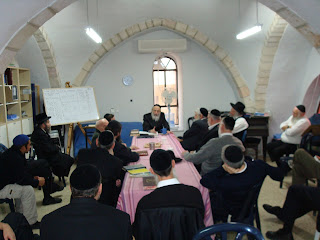 working for Rabbi Berel Wein-also great lover of k’lal Yisrael who has dedicated his life to teaching all Jews about their heritage. This position promises to be an exciting challenge, too. Those nine months between jobs afforded David the once in a lifetime opportunity to learn Torah full time. He loves learning at Yeshiva Rabbi Akiva, it is tailor made for him. Rabbi Gold is kind and serious, and understands both the limitations and aspirations of his talmidim. They work hard to earn their share in Torah.
Now it is bein hazmanim. Yeshivas have been on vacation since Rosh Chodesh Nisan, and this week the whole country is on vacation from work. Everyone is free. Free to be with family, free to travel this outrageously beautiful Land. But first, we cleaned and planned, purchased and prepared. We made our one, pure Seder.
In the Hagaddah, we said “...He took us out from there in order to bring us to Eretz Yisrael and to give us the land that He promised to our ancestors.” The ultimate purpose for which Hashem took us out of Egypt was to make us a nation, to give us His Torah and to bring us to the Land so that we can serve Him here. He did it in the blink of an eye-after centuries of suffering and yearning.
And miraculously, here we are. Our aliya anniversary lands squarely between Yom Ha’atzmaut, the day commemorating the miracle of the modern state of Israel and Yom Yerushalyim, the day of the miracle of a unified Jerusalem. Since we know that there are no coincidences, we’ve wondered about the message in this juxtaposition.
Jews began coming home en masse just 60 years ago. Untrained farmers and poorly armed fighters, with help from Above, built this country into a world economic power on a foundation of hope. It happened in the blink of an eye- after a long, dark disastrous decade...and Hashem’s promise to our forebears over 3,600 years ago. Then Jerusalem was given into our hands in 1967- in the blink of an eye-after 6 miraculous days and 2000 years of our longing.
Salvation comes in the blink of an eye. I thought of this over Chol haMoed when crowds came to pray at the Kotel at sunrise. While the night sky still hovered, we covered our eyes and said Shema, thousands of Jews together. Suddenly the black peeled away and revealed a sky turned that true Jerusalem blue. The Shema left us with clarity that, G-d who is merciful, is the true Judge, the same One who loves us.
Here we stand again –arab armies and world opinion a wall of ill will surrounding us. The only place to look is up. It may seem that we are alone in the black night, but dawn will soon break and we’ll then see that Hashem’s love and mercy have been surrounding us the whole time.
The great Chassidic rabbi, Rabbi Elimelech of Lizhensk says that in times of trouble we should talk of the miracles that Hashem performed in Egypt, and through this, He will continue to perform great miracles of salvation. At our Seder we talked about how the miracles of Pesach story are the paradigm for the future salvation. Those miracles will be even greater than we can imagine! We also said that even though it is a miracle that we are a distinct nation with the living Torah and our home is Israel, without the Bais haMikdash, the ultimate purpose of our nationhood and Torah are not realized. And so, our Seder here in the Old City of Jerusalem ended just like yours did: “l’shana haba b’Yerushalyim.”
May we merit to see the Almighty’s miracles. May we speak about them throughout the year, and may all of His children-in the blink of an eye- come home soon.
Love,
Renee and David ...
22 Nissan 5768
Isru Chag shel Pesach
April 27, 2008
Dear Friends and Family,
As the first year anniversary date of our aliya approaches we want to acknowledge our gratitude to Hashem for all He did to bring us here. For ten years we talked of living in Eretz Yisrael. It was our dream. Until the day David said that if we did not set a date to work towards, it would remain just a dream. So we looked at our life and set our date for three years into the future: May 7, 2007. We started to plan. Of course, G-d laughed.
Our aliya story is a megilla of hidden and revealed miracles.
December 2006. Five months before our projected aliya date, things were not coming into focus. David felt he could not responsibly leave his position until the company he worked with, could hire medical sales professionals. He was trapped. They had no present plan to make this hire and we had no parnassa plan for Israel. However, David said things could change in the blink of an eye, so we started filling out the Nefesh b’Nefesh paperwork.
By February it was time for us to renew our lease at the apartment we’d rented as part of our aliya plan, which had included selling our house. We had a decision to make. Renew for a year, six months or three? We calculated the costs to sign at a lower rent for year and break it when things hopefully fell into place. Would it be wiser to commit to staying 6 months at a bit higher rent? It was quite pricey to sign for three months, yet that would bring us almost exactly to May 7, the date we’d chosen three years earlier. It had seemed so, so far away then. Now May 7, 2007 would be here in the blink of an eye. We decided to show Hashem that we wanted to come and we meant it. We signed for three. If He wanted us, we’d be ready.
The next week, David was somewhere he’d not been in 3 years: home in the middle of the day during the workweek. He was between appointments and decided since he was closeby, that eating his packed lunch on a table at home was nicer than eating in his car. On that day at that time, his cellphone rang. It was Rabbi Solomon who wanted to know if he’d be interested in working for HaRosh Yeshiva Noach Weinberg, may he have a refuah sheleima. This amazing opportunity came in the blink of an eye-after 10 years of prayer and effort.
An interview in Jerusalem was arranged for mid-March. David and I both felt that this position with Aish was a long shot, besides he still had that commitment to the company he was with. But the chance to spend a week with Rav Noach, shlita, was worth the trip alone and if that was not working out, then maybe another opportunity would arise while he was there. Just a few days after he booked his flight, David came home in the middle of the day again. This time he had news: management had finally decided to put on a medical sales team! In the blink of an eye, he was free...and we were jobless as well as homeless.
The interview in Jerusalem at Aish headquarters lasted a week and after a few days, all thought it was a match made in heaven. The compensation they offered was considerably less than a US salary but plenty to live on here, and the position was irresistible because it would, number one: be an exciting employment of David’s talents and energies on behalf on k’lal Yisrael and number two: get us to Israel: start date may 20.
I began a serious apartment search. Before David left, I had posted our desire for a 3BR 2 BA apartment with A/C on yahoogroups, luach, and flathunting. David was going to work in just 8 weeks, we needed a place soon and we preferred to live in, or at least near the Old City. I spent hours combing real estate listings, emailing agents and calling potential landlords. Nothing. Then, in the blink of an eye, that very week David was in Jerusalem, an apartment suddenly appeared on luach.com. David looked at it immediately. It was the apartment of our dreams, and still is...less one bathroom.
After a gracious outpouring of kindness and well wishes from our Atlanta community and mesiras nefesh, self sacrifice by our family who had to say good bye, we flew New York to catch our free El Al flight on May 7, 2007. But without David’s passport. It had vanished, and we weren’t going over the ocean without it! It was a tense, trying two days in New York to obtain another passport and aliya visa. The overnight passport agent charged $500 for his services, miraculously, I had stashed exactly five $100 bills –for emergency-in the same envelope that I thought held both our passports. On the afternoon of May 9, we stood in the consulate lobby with the Israeli guard who cried with us when our aliya shaliach exited the elevator, brand new passport and visa in hand.
David’s tenure at Aish HaTorah lasted about as long as the blink of an eye: only 6 weeks—it was a wonderful experience but not a good fit. However, that job gave our aliya a practical basis and was very meaningful work, exactly what he needed at the time. A month ago, David began
 working for Rabbi Berel Wein-also great lover of k’lal Yisrael who has dedicated his life to teaching all Jews about their heritage. This position promises to be an exciting challenge, too. Those nine months between jobs afforded David the once in a lifetime opportunity to learn Torah full time. He loves learning at Yeshiva Rabbi Akiva, it is tailor made for him. Rabbi Gold is kind and serious, and understands both the limitations and aspirations of his talmidim. They work hard to earn their share in Torah.
Now it is bein hazmanim. Yeshivas have been on vacation since Rosh Chodesh Nisan, and this week the whole country is on vacation from work. Everyone is free. Free to be with family, free to travel this outrageously beautiful Land. But first, we cleaned and planned, purchased and prepared. We made our one, pure Seder.
In the Hagaddah, we said “...He took us out from there in order to bring us to Eretz Yisrael and to give us the land that He promised to our ancestors.” The ultimate purpose for which Hashem took us out of Egypt was to make us a nation, to give us His Torah and to bring us to the Land so that we can serve Him here. He did it in the blink of an eye-after centuries of suffering and yearning.
And miraculously, here we are. Our aliya anniversary lands squarely between Yom Ha’atzmaut, the day commemorating the miracle of the modern state of Israel and Yom Yerushalyim, the day of the miracle of a unified Jerusalem. Since we know that there are no coincidences, we’ve wondered about the message in this juxtaposition.
Jews began coming home en masse just 60 years ago. Untrained farmers and poorly armed fighters, with help from Above, built this country into a world economic power on a foundation of hope. It happened in the blink of an eye- after a long, dark disastrous decade...and Hashem’s promise to our forebears over 3,600 years ago. Then Jerusalem was given into our hands in 1967- in the blink of an eye-after 6 miraculous days and 2000 years of our longing.
Salvation comes in the blink of an eye. I thought of this over Chol haMoed when crowds came to
 pray at the Kotel at sunrise. While the night sky still hovered, we covered our eyes and said Shema, thousands of Jews together. Suddenly the black peeled away and revealed a sky turned that true Jerusalem blue. The Shema left us with clarity that, G-d who is merciful, is the true Judge, the same One who loves us.
Here we stand again –arab armies and world opinion a wall of ill will surrounding us. The only place to look is up. It may seem that we are alone in the black night, but dawn will soon break and we’ll then see that Hashem’s love and mercy have been surrounding us the whole time.
The great Chassidic rabbi, Rabbi Elimelech of Lizhensk says that in times of trouble we should talk of the miracles that Hashem performed in Egypt, and through this, He will continue to perform great miracles of salvation. At our Seder we talked about how the miracles of Pesach story are the paradigm for the future salvation. Those miracles will be even greater than we can imagine! We also said that even though it is a miracle that we are a distinct nation with the living Torah and our home is Israel, without the Bais haMikdash, the ultimate purpose of our nationhood and Torah are not realized. And so, our Seder here in the Old City of Jerusalem ended just like yours did: “l’shana haba b’Yerushalyim.”
May we merit to see the Almighty’s miracles. May we speak about them throughout the year, and may all of His children-in the blink of an eye- come home soon.
Love,
Renee and David ...
Coming Home & Back Again
B”H
17 Kislev 5768
November 27, 2007
Last Wednesday morning, jet lag awakened me before dawn and urged me to the Kotel early. I made my way just as I have done most mornings for the past six months. This time, though, it felt like the first time. The air was damp and chilly with intermittent sprinkles on slippery stones that kept many daybreak daveners snuggled in their warm homes. I love this weather because it holds the very air, the same cloud streaked skies and hovering chance of rain that welcomed and accompanied us throughout ten days in Kislev 1994, the first time we walked these stones and were kissed by the sweet clarity of the winter air.
This morning felt just like it did thirteen years ago, the morning of our first encounter with the remnant of our holy Temple, when our taxi wound its way down the steep road to the Kotel traffic circle and we watched the sky expand in pink and golden light as the sun emerged over the Har HaBayit.
Thirteen years ago David and I had no idea what Jerusalem, and Judaism for that matter, could mean to us. This was to be an adventure, a once in a lifetime vacation. We had guides lined up to take us to historical excavations, side trips planned so we could enjoy Israel’s natural beauty and interesting restaurant recommendations that we wanted to try. The restaurants offered new foods and presentations, our hikes were gorgeous, but it was the guide who gave us Jerusalem to whom we will always be indebted.
We spent three days with Barnea Selevan traipsing around the Old City and visiting every yeshiva (we had never been in one yeshiva, let alone half a dozen in one day). We explored the lives of Jews who came before us in every excavation, and learned about our cherished history in every museum and monument within these walls. We had questions and Barnea had answers. We had concerns, he understood them. We were developing ideas and he had a few of his own.
In the end, we took our lingering questions, nagging concerns and inspiring ideas back to Atlanta with us, but we also had something else to take home. Barnea held out a gift and he challenged us to take it. It was Yerushalyim. It was as if he was saying, “It’s your home, now what are you going to do with it?”
Of course, Atlanta was our home. Our loving family, good friends and supportive community are a reasonable definition of what a home is supposed to be. We had no family in Israel, few friends and no sense of community whatsoever. Our entire adult lives were spent in Atlanta. We’d spent a total of eight days in Jerusalem, yet we knew we’d forever be homesick for her as soon as our return flight lifted its wheels off the runway.
You all know the end of that story. Israel, Jerusalem in particular, is now-miraculously- our home.
Still, our ties remain strong to Atlanta and to everyone in America whom we hold dear, so two weeks ago I flew off for a week of concentrated catching up with my family and friends. Recurring questions settled on me everywhere I went: “What strikes you most about being back?” “Is being in America hard after being in Israel for so long?” “What do you miss most about Atlanta?” “…about Israel?” “What do you think about the Peace Process?” “What’s the prevailing attitude in Israel?”
And finally, “It doesn’t seem like anyone there cares...” Not a question, but it certainly does beg for an answer.
Of course we care. Every Jew cares.
Of course, I care. I care if our enemies will not only shoot fireworks on Friday night, but aim kassams at my neighbors, making French Hill another Sderot. Of course I care that our corrupt “leaders” think it will benefit our security to hand over to our enemies our security barrier of the Golan and once again exile Jews from their homes. It’s crazy. And I care that my government in America, in search of “signs of progress,” turns to the weakest party--banking on Israel’s capitulation --to save the administration from humiliation. Again.
Today is no different really than Begin,Sadat & Carter; then Rabin, Arafat & Clinton; then Netanyahu, Arafat & Clinton; then Barak, Arafat & Clinton; finally Olmert, Abbas and Bush. Now it's Mitchell, Clinton/Clinton & Abbas/Hamas. Don’t we get it?
It has always been Israel, Ishmael and Eisav. This is a struggle about gaining our inheritance, the Land of Israel.
Each of these leaders will bear responsibility for what he does...but ultimately God decides. He is involved in the tiny nuances of our lives and He is running the world according to His plan, taking care to worry us, pain us and distance us only as much as we can bear.
Three things, says the Talmud, are gained only through suffering: Torah, Eretz Yisrael and Olam Haba. But these are our inheritance, why make us suffer? Because suffering forces us to choose. We can choose to distract ourselves with our busy lives to alleviate our pain, or we can choose to look closely at ourselves and see what the Almighty requires of us to alleviate His pain.
Living in this Land, it is so easy to love God. Surrounded by incomplete, broken Jews just like me, I know He is compassionate.
 Driving through Judea and gazing at His hills dotted with homes filled with Jewish children, I know how much nachas we are able to give Him. Seeing hundreds of tourists each day huddled in dozens of groups around their guides in the Kotel plaza speaking Ivrit, English, Russian, French, German, Spanish, French and perhaps Swahili (really)... I know He wants the whole world to know Him. Talking to the bare headed driver who says Jerusalem is the best city in the world because Jews living here is a fulfillment of God’s Plan, I know every Jew can have an intimate relationship with Him.
We are in a struggle for our Land. God demands that we be worthy of it. That is all.
Be compassionate, give Him nachas, show the world there is a God, and talk to Him all the time.
God alone directs the hand of man. When we realize that we have no one to rely on-not this Prime Minister’s intellect, not the Presidential office, not the State Department, not Congressional clout and not even the IDF’s strength—no one except God. And we step up to the plate and ask Him, with all of our hearts-Bonei b’rchamav Yerushalyim....
Jerusalem is a gift and we are each challenged us to take it. Hashem is saying, “It’s your home, now what are you going to do with it?!”
Most of you aren’t here yet...but you yearn to be here, don’t you? And maybe that causes you pain. We are all suffering in this Galus. Through our suffering, we are acquiring the Land. He is only asking that we use the pain of separation to become the Jew who can inherit the Land that He so badly wants us to be worthy of.
May we all come home soon.
-Renee & David ...
17 Kislev 5768
November 27, 2007
Last Wednesday morning, jet lag awakened me before dawn and urged me to the Kotel early. I made my way just as I have done most mornings for the past six months. This time, though, it felt like the first time. The air was damp and chilly with intermittent sprinkles on slippery stones that kept many daybreak daveners snuggled in their warm homes.
 I love this weather because it holds the very air, the same cloud streaked skies and hovering chance of rain that welcomed and accompanied us throughout ten days in Kislev 1994, the first time we walked these stones and were kissed by the sweet clarity of the winter air.
This morning felt just like it did thirteen years ago, the morning of our first encounter with the remnant of our holy Temple, when our taxi wound its way down the steep road to the Kotel traffic circle and we watched the sky expand in pink and golden light as the sun emerged over the Har HaBayit.
Thirteen years ago David and I had no idea what Jerusalem, and Judaism for that matter, could mean to us. This was to be an adventure, a once in a lifetime vacation. We had guides lined up to take us to historical excavations, side trips planned so we could enjoy Israel’s natural beauty and interesting restaurant recommendations that we wanted to try. The restaurants offered new foods and presentations, our hikes were gorgeous, but it was the guide who gave us Jerusalem to whom we will always be indebted.
We spent three days with Barnea Selevan traipsing around the Old City and visiting every yeshiva (we had never been in one yeshiva, let alone half a dozen in one day). We explored the lives of Jews who came before us in every excavation, and learned about our cherished history in every museum and monument within these walls. We had questions and Barnea had answers. We had concerns, he understood them. We were developing ideas and he had a few of his own.
In the end, we took our lingering questions, nagging concerns and inspiring ideas back to Atlanta with us, but we also had something else to take home. Barnea held out a gift and he challenged us to take it. It was Yerushalyim. It was as if he was saying, “It’s your home, now what are you going to do with it?”
Of course, Atlanta was our home. Our loving family, good friends and supportive community are a reasonable definition of what a home is supposed to be. We had no family in Israel, few friends and no sense of community whatsoever. Our entire adult lives were spent in Atlanta. We’d spent a total of eight days in Jerusalem, yet we knew we’d forever be homesick for her as soon as our return flight lifted its wheels off the runway.
You all know the end of that story. Israel, Jerusalem in particular, is now-miraculously- our home.
Still, our ties remain strong to Atlanta and to everyone in America whom we hold dear, so two weeks ago I flew off for a week of concentrated catching up with my family and friends. Recurring questions settled on me everywhere I went: “What strikes you most about being back?” “Is being in America hard after being in Israel for so long?” “What do you miss most about Atlanta?” “…about Israel?” “What do you think about the Peace Process?” “What’s the prevailing attitude in Israel?”
And finally, “It doesn’t seem like anyone there cares...” Not a question, but it certainly does beg for an answer.
Of course we care. Every Jew cares.
Of course, I care. I care if our enemies will not only shoot fireworks on Friday night, but aim kassams at my neighbors, making French Hill another Sderot. Of course I care that our corrupt “leaders” think it will benefit our security to hand over to our enemies our security barrier of the Golan and once again exile Jews from their homes. It’s crazy. And I care that my government in America, in search of “signs of progress,” turns to the weakest party--banking on Israel’s capitulation --to save the administration from humiliation. Again.
Today is no different really than Begin,Sadat & Carter; then Rabin, Arafat & Clinton; then Netanyahu, Arafat & Clinton; then Barak, Arafat & Clinton; finally Olmert, Abbas and Bush. Now it's Mitchell, Clinton/Clinton & Abbas/Hamas. Don’t we get it?
It has always been Israel, Ishmael and Eisav. This is a struggle about gaining our inheritance, the Land of Israel.
Each of these leaders will bear responsibility for what he does...but ultimately God decides. He is involved in the tiny nuances of our lives and He is running the world according to His plan, taking care to worry us, pain us and distance us only as much as we can bear.
Three things, says the Talmud, are gained only through suffering: Torah, Eretz Yisrael and Olam Haba. But these are our inheritance, why make us suffer? Because suffering forces us to choose. We can choose to distract ourselves with our busy lives to alleviate our pain, or we can choose to look closely at ourselves and see what the Almighty requires of us to alleviate His pain.
Living in this Land, it is so easy to love God. Surrounded by incomplete, broken Jews just like me, I know He is compassionate.
 Driving through Judea and gazing at His hills dotted with homes filled with Jewish children, I know how much nachas we are able to give Him. Seeing hundreds of tourists each day huddled in dozens of groups around their guides in the Kotel plaza speaking Ivrit, English, Russian, French, German, Spanish, French and perhaps Swahili (really)... I know He wants the whole world to know Him. Talking to the bare headed driver who says Jerusalem is the best city in the world because Jews living here is a fulfillment of God’s Plan, I know every Jew can have an intimate relationship with Him.
We are in a struggle for our Land. God demands that we be worthy of it. That is all.
Be compassionate, give Him nachas, show the world there is a God, and talk to Him all the time.
God alone directs the hand of man. When we realize that we have no one to rely on-not this Prime Minister’s intellect, not the Presidential office, not the State Department, not Congressional clout and not even the IDF’s strength—no one except God. And we step up to the plate and ask Him, with all of our hearts-Bonei b’rchamav Yerushalyim....
Jerusalem is a gift and we are each challenged us to take it. Hashem is saying, “It’s your home, now what are you going to do with it?!”
Most of you aren’t here yet...but you yearn to be here, don’t you? And maybe that causes you pain. We are all suffering in this Galus. Through our suffering, we are acquiring the Land. He is only asking that we use the pain of separation to become the Jew who can inherit the Land that He so badly wants us to be worthy of.
May we all come home soon.
-Renee & David ...
A Mundane Day
B”H
Cheshvan 18, 5768
October 20, 2007
Dear Friends and Family,
The chaggim are over, we have reclaimed the routine of a six day work week and life is beginning to feel somewhat “normal,” whatever that means. Weeks without holidays to prepare for (and recover from) spread into a stream of days, one after the next filled with getting things done. I have time to finally unpack the last remaining boxes of books, winter clothing and rain gear. Where I will put them, I have no idea. I have time to plan a week of menus and shop more frugally. The laundry will all be done and now I have no excuse for a full ironing basket. With that in mind, I thought that in this letter I would answer a friend when she told me she really wanted to know what a mundane day in Jerusalem was like for me.
This letter will most likely appeal to the women among you. I can’t imagine men being interested in my lists and learning or my adventures procuring needed food items, etc. Hopefully, David will write the next letter, one that should interest the men: “How I Got My Israeli Driver’s License in 9 Easy Steps (give or take a few).” And we don’t even have a car.
As for me, on a mundane day I wake at about 6 in the morning. Above me there is the stone lintel from a Byznatine era column that was uncovered with much excitement in the renovation of this apartment. The column was probably built here before the 7th century, making the home we live in over 1400 years old!
By the time I am having my coffee in our 1400 year-old living room (usually Starbucks, one of the few things I ask people to bring me from America), I hear David coming up the stairs with his Rosh Yeshiva, Rabbi Shalom Gold. They are returning from neitz, sunrise, davening at the Kotel. David has been learning the Gemara in Brachos about how one should do no mundane activity before greeting the One who fashioned us. As a very early riser, he enjoyed his lone routine of exercise, reading the news and doing some office work before his 7 a.m. minyan. However, the more one learns, the more one does-and he just did not feel it was right to begin davening after immersing himself in those mundane activities. So, Rav Gold had the answer; although not the one my husband really wanted. However, now in to his second week of neitz, he says it enhances his entire day to begin by walking through the dark empty streets, dry off his shtender, moist with morning dew and say Shema just as the light permeates the Jerusalem sky with pinks and greys and golds.
He comes home quite hungry, so I make him breakfast, dress and now it’s my turn. The Kotel calls me, too. The streets are still quiet as I move down Misgav Ladach Street past a view of the Mount of Olives. Last month, we watched one afternoon from a distance as former Chief Rabbi Avraham Shapira. zt’l, escorted by tens of thousands of mourners just hours before Simchat Torah, was laid to rest there. I whisper a prayer asking the holy rabbis buried on this mountain-- where the prophet Zachariah said the Redeemer’s feet will stand at the final war-- to petition the Heavenly Courts on our behalf to keep us safe and bring us all home in peace.
My route continues past Aish HaTorah, down many sets of stairs and over the excavation of an ancient marketplace at the back of the Kotel plaza. Each week, they uncover more evidence of the mundane lives of those who lived in my neighborhood centuries before me, when Jews could actually go the to Holy Temple. Today, my avoda is offered meters below the Har HaBayit, in the tunnels of the Western Wall. I enter where the Tunnels Tour begins and wind my way through the cave like corridors and cavernous rooms under houses where Moslems live. My goal is a beautiful women’s section, the closest we can get to the Kedosh Kedoshim, as close to the center of the universe as one can stand; then I pray Shacharit.
I would like to say that my kavana is amazingly better there. But that’s just not always true. The lists I need to add to and the conversation I had yesterday creep into my prayer and often I wonder how it is that I ended up at Shema. However, I just look up at the wall with its grey stones hewn into rectangles as big as Chevy Suburbans, draw inspiration from the spiritual refinement of women praying around me, and look down at my feet in utter humility. Although prayer is still a struggle, my awe is greater, as is my gratitude.
When I return home, David goes off to Yeshiva Rabbi Akiva and for me, the lists are waiting. I add what I remember, check my email and gather up a load of wash. My breakfast is usually rice cakes and hummos with tomatoes, which, even near November and even in shmitta remain delicious.
This morning I had a yoga class. I have long benefited from this form of exercise, but in America I was bothered because (except for Tzipporah Metzel’s class) every instructor tainted her instruction with yoga’s avoda zara origins. Sara, our instructor, punctuates her instruction with diveri Torah. She and several of my co-students, have known each other since just after the 6 Day War when, as spiritual seekers, they found themselves living together on Har Tzion, learning at the Diaspora Yeshiva and marrying boys also becoming observant there. One of these women, Chaya Makla Abramson, still lives on Har Tzion. She is a living miracle, a woman who radiates warmth and emuna, whose courageous story is told in her book, Who By Fire (Feldheim). Each of them has an inspiring story that, in the weeks since I have joined them, slip out and reveal to me the special nature of these pioneers, whose very lives as mothers in Israel, have helped us reclaim our inheritance.
It’s 11 a.m and I have to get groceries. This week I am using a new online delivery service called Digital City. This is one of the ways I know Hashem loves me! In Atlanta, I was one of the few who mourned the demise of Webvan. Digital City is all that and more. They buy from the grocery, the shuk, SuperPharm, the butcher, a wine store, fish market and cheese shop. I haven’t figured out if the hechshers are all good, so I still have to shop myself some weeks, but for staples DCity is great! My order took about 30 minutes to complete and I chose to have them deliver tomorrow afternoon.
The brick and mortar store I go to is Super Deal. It’s the second stop on the 38 and a short walk, down an alley past a bar and behind the old train station. So much for location, location, location. It hasn’t hurt their business as they have been there for years, and it shows in their assortment of mismatched carts and rustic produce bins. Surprisingly, I find everything I need here. American products cost 3 to 4 times as much. We do buy Philadelphia cream cheese at 16 shekels and Ortega Taco Shells at 28. Pancake mix and syrup are still part of our pantry and they are ridiculously high. Other than those few items, Israeli products are of good quality and reasonably priced. The checkout people do not like to speak English, so I try my best to give them the address and phone number in Ivrit. Arab boys will deliver “b’erev,” meaning sometime between 2 and 9 pm. I have learned it is best to take my frozen and dairy items with me.
After this monthly grocery spree, I usually catch the bus up to King George and walk over to Chofetz Chaim, a butcher on Agrippas. I like them because they have a wide variety of meat, some fish and are English friendly. The woman who works there fondly remembers living in the same building as Rabbi Emanuel Feldman in Baltimore. She helps me to understand the mystery meat here: like what is a #5, a # 3? London Broil is not like at Steve’s, it is twice as thick with a stretch of gristle in the middle, making it a lot of trouble to eat. Steak is entrecote. Period. Cholent meat comes in uniform square chunks similar to large ice cubes. I often strike up a conversation with another shopper who tells me how she cooks the cut she pulls out of the case. Once I bought what I thought was a simple boneless rolled turkey breast, and when I sliced it, discovered it was stuffed with what we think was ground meat. In a happy accident, I discovered turkey shnitzel. This makes a moist and flavorful breaded cutlet for Shabbos day. For 20 shekels, Chofetz Chaim delivers, so I buy enough for several weeks and take my bubby cart full of cold dairy items in search of an iced coffee.
Anglo-Israelis like me, find iced coffee on a warm October day is essential. I know I should really be drinking water, but there is reward in this creamy, sweet, energizing formula that refreshes in a way that water cannot.
I like to walk with other Jews on Jerusalem streets named Hillel and Shammai, Rishonim and Misilat Yesharim. Sometimes I will walk all the way home from town, and sometimes just wander until I think I better get my things to the fridge, so I catch the 38 down at the bottom of Ben Yehuda. I used to squeeze in a trip to the bank, but I finally figured out how to check my balance online, and that is all I need from that bank. They are not at all English friendly. After our klita payments are all deposited, we are closing the account and moving to one I hope will be more accommodating. When you get here, I will tell you where NOT to bank.
By the time I return home, put the groceries in the refrigerator, tend the laundry and check my email, America is waking up. I try to talk to Elise every day in between her work and school. She sometimes feels very alone over there, with her entire (all 3 of us) family here. So, I feel it is important to share my day and hear what she’s up to. I try to catch up and learn on the phone, thanks to VOIP, with one or two people in America each week. The days go by for me as well as you and the time frame is limited, so I don’t keep in touch as much as I like.
David comes home from yeshiva at 2 for lunch and has a couple of hours to run an errand or do some work. He really loves the learning, and although he is not working, just keeping up with a little business in America that helps us out, I feel he needs to do this now. Never has he been in a serious yeshiva that accommodates his lack of background and still challenges him. His years learning at the ASK Yesodei HaTorah in Atlanta laid the groundwork for this. One of these days, he’ll write a letter about Yeshiva Rabbi Akiva and many of you will want your husbands to learn there, too.
In the afternoons, I try do some of that unpacking I was talking about earlier or clean out a closet that has already accumulated things we do not need. Sometimes I have the opportunity to do something to help someone out, just like you often do. Sometimes I have an appointment at the doctor, or I have to wait for a repairman, just like you have to do. Once a month Rabbi Keleman gives an astonishingly life changing shiur in the Rova, and sometimes I’ll write. Like today.
And then it is time to make dinner, on a mundane day, it’s just the two of us. We eat together and David talks about his day; that means I usually get a taste of what he learned over our meal. Delicious. Today Rabbi Aba Wagensberg taught for an hour on tefilla. Tefilla, he said is taking our shopping list of wants and desires to Hashem, Who certainly knows –and gives us—exactly what we need to accomplish our mission on this earth. Why do we have to ask when He will always give us everything we require? Because prayer is for us. To take it into our heart that our mission is not to serve to procure our needs (the shopping list), but to serve Him-by taking what He gives us, and using it to bring ourselves to shelimut. Perfection, completion.
On Sunday nights, I attend a shiur Rebbetzin Heller has been giving for 18 years at Sara Rigler’s house. Now we are learning from Path of the Just on fighting the Yetzer Hara. I like her class because she, like Rabbi Keleman gives us “homework,” something concrete to do or notice to actualize the concepts she presented. This week, she talked about how the Yetzer Hara distracts us, keeps us busy with the mundane and overwhelms us and robs us of our inner space. The Yetzer Hara knows that if we focus on that inner space, there won’t be any room for him. This week our homework is to focus on our inner space for 15 minutes throughout the day: review our actions, examine our mistakes and plan what to do different the next time --- while we are doing something mundane.
On a mundane day, I do just about the same things any woman does. I wake, daven, do chores, shop and cook. It almost never feels mundane. Mundane days are not for Israel. Mundane days are not for Jews.
A mundane day does not start at the Kotel haMaaravi. On a mundane day, one does not do yoga with a woman who staked her claim in the land of our forefathers when it was far from fashionable, far from easy. Walking on streets named for holy books and holy men doesn’t ever happen on mundane days. However, I make them mundane by going through the motions of tefilla, riding on the bus with mindless thoughts or attending a shiur expecting what I hear to change me-without my doing the work to grow.
You can feel you are davening at the center of the world even if you are standing in your living room in Atlanta, Ga. That is not mundane. When you drive into the Kroger parking lot and pray that Hashem will open a spot not too far up the hill and that the vegetables will be fresh and the things on your shopping list will be in stock, that’s not mundane. As you drive to work or carpool and think about where it is that you really need to go in life—and open a spot inside to hear what Hashem answers; when we do this, there is never a mundane day.
Have an extraordinary day, and come home soon.
Love,
Renee ...
Cheshvan 18, 5768
October 20, 2007
Dear Friends and Family,
The chaggim are over, we have reclaimed the routine of a six day work week and life is beginning to feel somewhat “normal,” whatever that means. Weeks without holidays to prepare for (and recover from) spread into a stream of days, one after the next filled with getting things done. I have time to finally unpack the last remaining boxes of books, winter clothing and rain gear. Where I will put them, I have no idea. I have time to plan a week of menus and shop more frugally. The laundry will all be done and now I have no excuse for a full ironing basket. With that in mind, I thought that in this letter I would answer a friend when she told me she really wanted to know what a mundane day in Jerusalem was like for me.
This letter will most likely appeal to the women among you. I can’t imagine men being interested in my lists and learning or my adventures procuring needed food items, etc. Hopefully, David will write the next letter, one that should interest the men: “How I Got My Israeli Driver’s License in 9 Easy Steps (give or take a few).” And we don’t even have a car.
As for me, on a mundane day I wake at about 6 in the morning. Above me there is the stone lintel from a Byznatine era column that was uncovered with much excitement in the renovation of this apartment. The column was probably built here before the 7th century, making the home we live in over 1400 years old!
By the time I am having my coffee in our 1400 year-old living room (usually Starbucks, one of the few things I ask people to bring me from America), I hear David coming up the stairs with his Rosh Yeshiva, Rabbi Shalom Gold. They are returning from neitz, sunrise, davening at the Kotel. David has been learning the Gemara in Brachos about how one should do no mundane activity before greeting the One who fashioned us. As a very early riser, he enjoyed his lone routine of exercise, reading the news and doing some office work before his 7 a.m. minyan. However, the more one learns, the more one does-and he just did not feel it was right to begin davening after immersing himself in those mundane activities. So, Rav Gold had the answer; although not the one my husband really wanted. However, now in to his second week of neitz, he says it enhances his entire day to begin by walking through the dark empty streets, dry off his shtender, moist with morning dew and say Shema just as the light permeates the Jerusalem sky with pinks and greys and golds.
He comes home quite hungry, so I make him breakfast, dress and now it’s my turn. The Kotel calls me, too. The streets are still quiet as I move down Misgav Ladach Street past a view of the
 Mount of Olives. Last month, we watched one afternoon from a distance as former Chief Rabbi Avraham Shapira. zt’l, escorted by tens of thousands of mourners just hours before Simchat Torah, was laid to rest there. I whisper a prayer asking the holy rabbis buried on this mountain-- where the prophet Zachariah said the Redeemer’s feet will stand at the final war-- to petition the Heavenly Courts on our behalf to keep us safe and bring us all home in peace.
My route continues past Aish HaTorah, down many sets of stairs and over the excavation of an ancient marketplace at the back of the Kotel plaza. Each week, they uncover more evidence of the mundane lives of those who lived in my neighborhood centuries before me, when Jews could actually go the to Holy Temple. Today, my avoda is offered meters below the Har HaBayit, in the tunnels of the Western Wall. I enter where the Tunnels Tour begins and wind my way through the cave like corridors and cavernous rooms under houses where Moslems live. My goal is a beautiful women’s section, the closest we can get to the Kedosh Kedoshim, as close to the center of the universe as one can stand; then I pray Shacharit.
I would like to say that my kavana is amazingly better there. But that’s just not always true. The lists I need to add to and the conversation I had yesterday creep into my prayer and often I wonder how it is that I ended up at Shema. However, I just look up at the wall with its grey stones hewn into rectangles as big as Chevy Suburbans, draw inspiration from the spiritual refinement of women praying around me, and look down at my feet in utter humility. Although prayer is still a struggle, my awe is greater, as is my gratitude.
When I return home, David goes off to Yeshiva Rabbi Akiva and for me, the lists are waiting. I add what I remember, check my email and gather up a load of wash. My breakfast is usually rice cakes and hummos with tomatoes, which, even near November and even in shmitta remain delicious.
This morning I had a yoga class. I have long benefited from this form of exercise, but in America I was bothered because (except for Tzipporah Metzel’s class) every instructor tainted her instruction with yoga’s avoda zara origins. Sara, our instructor, punctuates her instruction with diveri Torah. She and several of my co-students, have known each other since just after the 6 Day War when, as spiritual seekers, they found themselves living together on Har Tzion, learning at the Diaspora Yeshiva and marrying boys also becoming observant there. One of these women, Chaya Makla Abramson, still lives on Har Tzion. She is a living miracle, a woman who radiates warmth and emuna, whose courageous story is told in her book, Who By Fire (Feldheim). Each of them has an inspiring story that, in the weeks since I have joined them, slip out and reveal to me the special nature of these pioneers, whose very lives as mothers in Israel, have helped us reclaim our inheritance.
It’s 11 a.m and I have to get groceries. This week I am using a new online delivery service called Digital City. This is one of the ways I know Hashem loves me! In Atlanta, I was one of the few who mourned the demise of Webvan. Digital City is all that and more. They buy from the grocery, the shuk, SuperPharm, the butcher, a wine store, fish market and cheese shop. I haven’t figured out if the hechshers are all good, so I still have to shop myself some weeks, but for staples DCity is great! My order took about 30 minutes to complete and I chose to have them deliver tomorrow afternoon.
The brick and mortar store I go to is Super Deal. It’s the second stop on the 38 and a short walk, down an alley past a bar and behind the old train station. So much for location, location, location. It hasn’t hurt their business as they have been there for years, and it shows in their assortment of mismatched carts and rustic produce bins. Surprisingly, I find everything I need here. American products cost 3 to 4 times as much. We do buy Philadelphia cream cheese at 16 shekels and Ortega Taco Shells at 28. Pancake mix and syrup are still part of our pantry and they are ridiculously high. Other than those few items, Israeli products are of good quality and reasonably priced. The checkout people do not like to speak English, so I try my best to give them the address and phone number in Ivrit. Arab boys will deliver “b’erev,” meaning sometime between 2 and 9 pm. I have learned it is best to take my frozen and dairy items with me.
After this monthly grocery spree, I usually catch the bus up to King George and walk over to Chofetz Chaim, a butcher on Agrippas. I like them because they have a wide variety of meat, some fish and are English friendly. The woman who works there fondly remembers living in the same building as Rabbi Emanuel Feldman in Baltimore. She helps me to understand the mystery meat here: like what is a #5, a # 3? London Broil is not like at Steve’s, it is twice as thick with a stretch of gristle in the middle, making it a lot of trouble to eat. Steak is entrecote. Period. Cholent meat comes in uniform square chunks similar to large ice cubes. I often strike up a conversation with another shopper who tells me how she cooks the cut she pulls out of the case. Once I bought what I thought was a simple boneless rolled turkey breast, and when I sliced it, discovered it was stuffed with what we think was ground meat. In a happy accident, I discovered turkey shnitzel. This makes a moist and flavorful breaded cutlet for Shabbos day. For 20 shekels, Chofetz Chaim delivers, so I buy enough for several weeks and take my bubby cart full of cold dairy items in search of an iced coffee.
Anglo-Israelis like me, find iced coffee on a warm October day is essential. I know I should really be drinking water, but there is reward in this creamy, sweet, energizing formula that refreshes in a way that water cannot.
I like to walk with other Jews on Jerusalem streets named Hillel and Shammai, Rishonim and
 Misilat Yesharim. Sometimes I will walk all the way home from town, and sometimes just wander until I think I better get my things to the fridge, so I catch the 38 down at the bottom of Ben Yehuda. I used to squeeze in a trip to the bank, but I finally figured out how to check my balance online, and that is all I need from that bank. They are not at all English friendly. After our klita payments are all deposited, we are closing the account and moving to one I hope will be more accommodating. When you get here, I will tell you where NOT to bank.
By the time I return home, put the groceries in the refrigerator, tend the laundry and check my email, America is waking up. I try to talk to Elise every day in between her work and school. She sometimes feels very alone over there, with her entire (all 3 of us) family here. So, I feel it is important to share my day and hear what she’s up to. I try to catch up and learn on the phone, thanks to VOIP, with one or two people in America each week. The days go by for me as well as you and the time frame is limited, so I don’t keep in touch as much as I like.
David comes home from yeshiva at 2 for lunch and has a couple of hours to run an errand or do some work. He really loves the learning, and although he is not working, just keeping up with a little business in America that helps us out, I feel he needs to do this now. Never has he been in a serious yeshiva that accommodates his lack of background and still challenges him. His years learning at the ASK Yesodei HaTorah in Atlanta laid the groundwork for this. One of these days, he’ll write a letter about Yeshiva Rabbi Akiva and many of you will want your husbands to learn there, too.
In the afternoons, I try do some of that unpacking I was talking about earlier or clean out a closet that has already accumulated things we do not need. Sometimes I have the opportunity to do something to help someone out, just like you often do. Sometimes I have an appointment at the doctor, or I have to wait for a repairman, just like you have to do. Once a month Rabbi Keleman gives an astonishingly life changing shiur in the Rova, and sometimes I’ll write. Like today.
And then it is time to make dinner, on a mundane day, it’s just the two of us. We eat together and David talks about his day; that means I usually get a taste of what he learned over our meal. Delicious. Today Rabbi Aba Wagensberg taught for an hour on tefilla. Tefilla, he said is taking our shopping list of wants and desires to Hashem, Who certainly knows –and gives us—exactly what we need to accomplish our mission on this earth. Why do we have to ask when He will always give us everything we require? Because prayer is for us. To take it into our heart that our mission is not to serve to procure our needs (the shopping list), but to serve Him-by taking what He gives us, and using it to bring ourselves to shelimut. Perfection, completion.
On Sunday nights, I attend a shiur Rebbetzin Heller has been giving for 18 years at Sara Rigler’s house. Now we are learning from Path of the Just on fighting the Yetzer Hara. I like her class because she, like Rabbi Keleman gives us “homework,” something concrete to do or notice to actualize the concepts she presented. This week, she talked about how the Yetzer Hara distracts us, keeps us busy with the mundane and overwhelms us and robs us of our inner space. The Yetzer Hara knows that if we focus on that inner space, there won’t be any room for him. This week our homework is to focus on our inner space for 15 minutes throughout the day: review our actions, examine our mistakes and plan what to do different the next time --- while we are doing something mundane.
On a mundane day, I do just about the same things any woman does. I wake, daven, do chores, shop and cook. It almost never feels mundane. Mundane days are not for Israel. Mundane days are not for Jews.
A mundane day does not start at the Kotel haMaaravi. On a mundane day, one does not do yoga with a woman who staked her claim in the land of our forefathers when it was far from fashionable, far from easy. Walking on streets named for holy books and holy men doesn’t ever happen on mundane days. However, I make them mundane by going through the motions of tefilla, riding on the bus with mindless thoughts or attending a shiur expecting what I hear to change me-without my doing the work to grow.
You can feel you are davening at the center of the world even if you are standing in your living room in Atlanta, Ga. That is not mundane. When you drive into the Kroger parking lot and pray that Hashem will open a spot not too far up the hill and that the vegetables will be fresh and the things on your shopping list will be in stock, that’s not mundane. As you drive to work or carpool and think about where it is that you really need to go in life—and open a spot inside to hear what Hashem answers; when we do this, there is never a mundane day.
Have an extraordinary day, and come home soon.
Love,
Renee ...
A Very Different Sukkos

B”H
Cheshvan 2, 5768
October 14, 2007
Dear Family and Friends,
By Friday afternoon, Isru Chag, our scach ws neatly rolled, the decorations boxed away until next year and the sukkah walls and poles stacked and wrapped in a corner of our same courtyard where they stood linked together, for one majestic week.
Our sukkah arrived on the lift with just about everything else we own. It’s one of those interlocking metal bar and canvas types that have been so popular for their ease. Easy to erect, easy to store. Each year, that sukkah that has given us headaches: first, the parts were not all there. Then, after a very rainy Sukkos, we decided the grass was too messy so the next year David designed and built a wood floor--rendering ease of erection and storage benefits meaningless. Ever try to store a 10’ x12’ floor? Another time, the main beam broke, pressured by the weight of rain from a sudden downpour that settled on the tarp we put up to protect the scach. Three years, three trials. Honestly, the girls and I simply dreaded the day each year one of us would have to help David with this chore.
But, we brought the sukkah anyway. Change of place, change of mazel—maybe. But I think this was not the same sukkah.. Same frame and fabric, same scach and decoration. However, it was an entirely different sukkah.
This year our sukkah went up with barely a glitch in an hour or two with the assistance of a helpful aish student from Australia whom we have handily adopted. Already we had a hint that something was different.
Then, we literally moved in: our coffee table which raises to dining height to seat eight for the meals, also lowers to create the ambiance of our living room with the addition of a couple of comfortable chairs. Lamps, the portable phone, a vase of flowers and it was home for the week.
We don’t worry too much about leaving furniture in the sukkah all week because we don’t expect rain here on Sukkos. There is a bit of emuna that goes into it, as for a few days we saw something strange in the sky: clouds. But they soon made way for the familiar endless sapphire mantle that thrills us each time we raise our eyes heavenward.
From the kitchen where I, like almost every other woman I know, spent most of the chag, I could see right in our sukkah’s door and feel connected to whatever was going in there. David ate there, learned there and brought the laptop out to surf a bit. Visitors stopped by our sukkah, because everyone we know is also enjoying the holiday. I took a break now and again for snacks and chats and cozy chol hamoed meals.
Each evening, David did something he has felt comfortable doing only once or twice in our 15 years of sukkah dwelling. He slept in the sukkah, among our snoring neighbors. Other than an occasional rousing to shush yeshiva bochurs hanging out on the quiet streets at 2 am, or to shoo away a cat trying to get into the courtyard, he slept peacefully under a blanket of Jerusalem stars.

This was certainly a different sukkah. And a different Sukkos.
Sukkos here is a holiday for the entire country. Many people simply close their stores all week. Yeshivos and schools let out, offices and government services give time off and the country goes into vacation mode. Families go on tiyul; nature hikes and zoo outings are most popular. Many take day trips to lovely towns like Tzefat or Zichron Yaakov, with its charming shops and marvelous view of the Mediterranean.
Jerusalem, of course, is one of the main attractions. And everyone who comes to Jerusalem, comes to our neighborhood. We had plenty of opportunities to play Old City ambassadors, exercising our pure bred Southern hospitality in a land hardly known for being genteel. Imagine us-two recent Georgia transplants, helping third-generation Israelis of every dress code navigate their way through our crowded streets toward the place they all wanted to go. The Kotel, the object of every Jew’s heart--whether they know it or not.
The Kotel is like Hashem’s “homing device,” drawing these souls to the center of His universe—home to our Father.
And home to our sukkos, where we intimately enjoy His closeness.
The air in the sukkah, hovering in the Clouds of Glory, always feels different. But it was more so for us this year. We wanted to be inside it every moment, under its shadow, under that blue, blue sky. It was as if the astounding clarity of Jerusalem’s air and light was distilled within those same canvas walls, the same walls we arduously assembled in each of the previous years.
Erecting and living in our sukkah this year was infinitely easier. Life here in many was is also easier. The future is still scattered with roadblocks and stumbling blocks. But there are bridges, too.
We have been traveling from Elul to Simchas Torah under the shadow of the Har haBayit--days and weeks saturated with mercy, elevated with encouragement and potent with opportunity. Linked together, they brought us over expanses we could not have traversed had Hashem not been drawing us closer.
To a different sukkah, a different Sukkos and a different us.
None of us are the same people as when we began this journey over 50 days ago. Now, what choice do we have?-- other than to kiss the sukkah walls and say good bye. And where do we go from here? Most certainly, each of us will be led in the way in which our heart yearns to go. May it be with bracha.
Come home soon.
Rena & David ...
Rose Colored Glasses
B”H
Rosh Chodesh Elul
30 Av 5767
August 14, 2007
Dear Family and Friends,
I admit it. I came to Israel wearing rose colored glasses. When someone tells me their “issues” with Israel, I just don’t get it. So, when I hear things like beggars probably make fortunes, and people complain that everything is so expensive here, and the warning I recently read that pickpockets stroll the shuk at Machene Yehuda, I just don’t agree. In fact, I just heard someone say that we should all be as persistent in our goals as the people jingling their cups. And yes, American goods and meat are very expensive, but Israeli goods and produce are reasonably priced, especially if you know where to shop. Like the shuk, where I have never had a bad experience.
A few weeks ago, I met up with 10 year aliya veteran, Star Miller and soon to be olah, Leslie Lowenstien, for an outing to one of my favorite Jerusalem excursions: the shuk. This is an amazing place on a Thursday morning. The aisles are jammed with shoppers of every stripe pulling bubbe carts, old men collecting tzedeka, suppliers yelling as they navigate pallets on wheels trying to fill up the vegetable stands as fast as customers can load up with tomatoes, peppers of every color, eggplant, cucumbers, zucchini, melons, squashes, onions, garlic, red and white potatoes, crimson beets, enormous grapes, nuts and dates, luscious figs, overflowing herbs, pillars of aromatic spices, fish, pickles, olives, cheeses...and this is just the main aisle. Jostling is the norm, and forget about shomer negiah-shoving and shuffling men and women bump together as we move in and out of minuscule booths and delight in the cheapest prices on the freshest fruits and vegies.
The three of us entered the shuk and ogled the scene, discussing what we were cooking for Shabbos. I headed for the first place that looked enticing. Within about 7 minutes I had filled up and paid the proprietor for the overflowing contents of my cart: the makings of so many salads and side dishes-recipes that would keep me on my feet in the kitchen for several hours, but I couldn’t resist. It all just looked so good. The best food starts with the best ingredients. And this farmers’ market of the holy city is the source for the best beginnings I have ever encountered.

I met Leslie just out side the booth as Star eyed some exquisite tomatoes across the aisle. Leslie commented that she couldn’t find her American Express card this morning, no matter they don’t take credit here anyway-this is cash commerce only. But, she wondered, maybe she should cancel it. Star went for the tomatoes, they had golden-yellow ones, too-when she tried to buy a few figs from a basket, the salesperson scolded her and said she’d have to take the whole basket or nothing. Forget that. We bumped down the aisle together when a tzedeka collector approached. I always set aside a few coins every day because this is inevitable. Once I have given those 6-8 shekels, I can say “no” to the others this time and perhaps catch them the next time. Its a strategy I learned from Rebbetzin Tzipporah Heller: decide what to give ahead of time and give it graciously.
So, I reached in my open pouch for the smaller purse containing my money..which was not there! I left Leslie standing with the beggar and my vegetables to weave and push my way against traffic to the stand where I had just made my purchase. I asked the proprietor if I left my purse there. He only spoke Hebrew...so I looked frantically at all the bins, and then under them. No purse. Meanwhile, Star and Leslie were going through my cart and all the bags inside. No purse.
I went back to the shopkeeper and tried again. “Did you see my wallet? I just paid here!” Did I expect that he would magically have learned even a smattering of English in 3 minutes? Thankfully, There were two sturdy Chassidic women-wearing sensible shoes, dark suits, and shaitels with little black hats on top; one waiting in line and one paying. They translated for me-well, mis-translated. The owner thought I did not have my wallet and could not pay. He told me, via the two ladies, --something that can only happen here-- that I could take whatever I wanted and come back to pay him later. Well, I guess they do take credit here.
As kind as that was, it did not help. He did not have my purse. It was beginning to dawn on me that I had been pick pocketed. But just of my money and credit cards. Not my rose colored glasses.
Star suggested I say the prayer for finding a lost object. Since none of us knew it, we called her daughter, Rivka, who had me repeat after her and then told me to give tzedeka. Ironic, isn’t it? Trying to give tzedeka was just how I discovered my loss...and of course, now I had no money. So, Star gave me 20 shekels and, since I decided to go home and call the credit card companies, bus fare, too. As I was saying good-bye to my friends, we spotted a pretty bedraggled, lethargic man shuffling past us holding an old plastic cup containing only a few agarot (less than a shekel). From behind, I dropped the 20 shekel bill in his cup. He stopped in his tracks to stare at it, then look around in disbelief. Maybe his day was beginning to go better than mine.
I found my rose colored glasses and went out into the sun. The bus stop was all downhill and the way was shady. I passed one of the Chassidic translators on the way and she wished me bracha and hatzlacha (blessing and that things should go well). The 38 bus to the Rova pulled up as soon as I got to the stand. The bus driver looked confused when I paid for my fare. He recognized me, knew I had a chofshi, monthly bus pass, and looked mildly sympathetic when I told him what happened. That was the most emotion I had ever seen from him. Can you imagine driving the same 30 minute route through some of the most congested traffic in the world for 8 hours a day? But the zechus of driving all day in Jerusalem, Ir haKodesh!
Canceling credit cards is a breeze with internet and a VOIP line. I had already spent a lot of the cash in the purse for the vegetables I needed. I did loose my chofshi for July and had to buy a punch card called cartisia. May the loss be for a kappara. The new credit cards came in the mail to our US address and kind people will bring them when they come. It was a inconvenience, and it was annoying. But I was careless. I was warned that pickpockets stroll the shuk ,and I wore a bag that was a temptation to someone so inclined.
Israel is what it is, the good and the not so good. But there is so much good. Our cup is not just half full, it overflows with the bracha that our generation is zoche, merits, to be the one in which Jews can come home to Yerushalyim. Today is Rosh Chodesh Elul and the streets overflow with Jews coming to pray at the Kotel as they begin to do tshuva in anticipation of the coming Days of Awe. K’lal Yisrael overflows with so many good people who care about each other, that we-as Rabbi Kalman Rosenbaum says-”can’t let the perfect ruin the good.”
So, come home soon. And we will meet you in Yerushalyim with a dozen rose-colored glasses. You are going to need them.
Love,
David & Renee ...
Rosh Chodesh Elul
30 Av 5767
August 14, 2007
Dear Family and Friends,
I admit it. I came to Israel wearing rose colored glasses. When someone tells me their “issues” with Israel, I just don’t get it. So, when I hear things like beggars probably make fortunes, and people complain that everything is so expensive here, and the warning I recently read that pickpockets stroll the shuk at Machene Yehuda, I just don’t agree. In fact, I just heard someone say that we should all be as persistent in our goals as the people jingling their cups. And yes, American goods and meat are very expensive, but Israeli goods and produce are reasonably priced, especially if you know where to shop. Like the shuk, where I have never had a bad experience.
A few weeks ago, I met up with 10 year aliya veteran, Star Miller and soon to be olah, Leslie Lowenstien, for an outing to one of my favorite Jerusalem excursions: the shuk. This is an amazing place on a Thursday morning. The aisles are jammed with shoppers of every stripe pulling bubbe carts, old men collecting tzedeka, suppliers yelling as they navigate pallets on wheels trying to fill up the vegetable stands as fast as customers can load up with tomatoes, peppers of every color, eggplant, cucumbers, zucchini, melons, squashes, onions, garlic, red and white potatoes, crimson beets,
 enormous grapes, nuts and dates, luscious figs, overflowing herbs, pillars of aromatic spices, fish, pickles, olives, cheeses...and this is just the main aisle. Jostling is the norm, and forget about shomer negiah-shoving and shuffling men and women bump together as we move in and out of minuscule booths and delight in the cheapest prices on the freshest fruits and vegies.
The three of us entered the shuk and ogled the scene, discussing what we were cooking for Shabbos. I headed for the first place that looked enticing. Within about 7 minutes I had filled up and paid the proprietor for the overflowing contents of my cart: the makings of so many salads and side dishes-recipes that would keep me on my feet in the kitchen for several hours, but I couldn’t resist. It all just looked so good. The best food starts with the best ingredients. And this farmers’ market of the holy city is the source for the best beginnings I have ever encountered.

I met Leslie just out side the booth as Star eyed some exquisite tomatoes across the aisle. Leslie commented that she couldn’t find her American Express card this morning, no matter they don’t take credit here anyway-this is cash commerce only. But, she wondered, maybe she should cancel it. Star went for the tomatoes, they had golden-yellow ones, too-when she tried to buy a few figs from a basket, the salesperson scolded her and said she’d have to take the whole basket or nothing. Forget that. We bumped down the aisle together when a tzedeka collector approached. I always set aside a few coins every day because this is inevitable. Once I have given those 6-8 shekels,
 I can say “no” to the others this time and perhaps catch them the next time. Its a strategy I learned from Rebbetzin Tzipporah Heller: decide what to give ahead of time and give it graciously.
So, I reached in my open pouch for the smaller purse containing my money..which was not there! I left Leslie standing with the beggar and my vegetables to weave and push my way against traffic to the stand where I had just made my purchase. I asked the proprietor if I left my purse there. He only spoke Hebrew...so I looked frantically at all the bins, and then under them. No purse. Meanwhile, Star and Leslie were going through my cart and all the bags inside. No purse.
I went back to the shopkeeper and tried again. “Did you see my wallet? I just paid here!” Did I expect that he would magically have learned even a smattering of English in 3 minutes? Thankfully, There were two sturdy Chassidic women-wearing sensible shoes, dark suits, and shaitels with little black hats on top; one waiting in line and one paying. They translated for me-well, mis-translated. The owner thought I did not have my wallet and could not pay. He told me, via the two ladies, --something that can only happen here-- that I could take whatever I wanted and come back to pay him later. Well, I guess they do take credit here.
As kind as that was, it did not help. He did not have my purse. It was beginning to dawn on me that I had been pick pocketed. But just of my money and credit cards. Not my rose colored glasses.
Star suggested I say the prayer for finding a lost object. Since none of us knew it, we called her daughter, Rivka, who had me repeat after her and then told me to give tzedeka. Ironic, isn’t it? Trying to give tzedeka was just how I discovered my loss...and of course, now I had no money. So, Star gave me 20 shekels and, since I decided to go home and call the credit card companies, bus fare, too. As I was saying good-bye to my friends, we spotted a pretty bedraggled, lethargic man shuffling past us holding an old plastic cup containing only a few agarot (less than a shekel). From behind, I dropped the 20 shekel bill in his cup. He stopped in his tracks to stare at it, then look around in disbelief. Maybe his day was beginning to go better than mine.
I found my rose colored glasses and went out into the sun. The bus stop was all downhill and the way was shady. I passed one of the Chassidic translators on the way and she wished me bracha and hatzlacha (blessing and that things should go well). The 38 bus to the Rova pulled up as soon as I got to the stand. The bus driver looked confused when I paid for my fare. He recognized me, knew I had a chofshi, monthly bus pass, and looked mildly sympathetic when I told him what happened. That was the most emotion I had ever seen from him. Can you imagine driving the same 30 minute route through some of the most congested traffic in the world for 8 hours a day? But the zechus of driving all day in Jerusalem, Ir haKodesh!
Canceling credit cards is a breeze with internet and a VOIP line. I had already spent a lot of the cash in the purse for the vegetables I needed. I did loose my chofshi for July and had to buy a punch card called cartisia. May the loss be for a kappara. The new credit cards came in the mail to our US address and kind people will bring them when they come. It was a inconvenience, and it was annoying. But I was careless. I was warned that pickpockets stroll the shuk ,and I wore a bag that was a temptation to someone so inclined.
Israel is what it is, the good and the not so good. But there is so much good. Our cup is not just half full, it overflows with the bracha that our generation is zoche, merits, to be the one in which Jews can come home to Yerushalyim.
 Today is Rosh Chodesh Elul and the streets overflow with Jews coming to pray at the Kotel as they begin to do tshuva in anticipation of the coming Days of Awe. K’lal Yisrael overflows with so many good people who care about each other, that we-as Rabbi Kalman Rosenbaum says-”can’t let the perfect ruin the good.”
So, come home soon. And we will meet you in Yerushalyim with a dozen rose-colored glasses. You are going to need them.
Love,
David & Renee ...
Subscribe to:
Posts (Atom)


 Posts
Posts


