Showing posts with label Parnassa. Show all posts
Showing posts with label Parnassa. Show all posts
The Unpredictability of Reliability
B"H
28thElul 5770
September 7, 2010
Dear Friends and Family,
With Rosh Hashana no longer just around the corner, but looming right before us, the business of taking stock of ourselves is unavoidable. Shiurim are filled to capacity and now everyone-Asheknazim and Sephardim- is getting up early for Slichos. The Old City streets are flowing at all hours with every kind of Jew visiting their Father at the holy Kotel, seeking forgiveness and a year in which their heartfelt prayers will be answered.
With so many people out and about, I’m sure to run into someone I haven’t seen in a while. So a chance meeting with Naomi last Shabbat was no surprise. Neither was the content of our conversation. After a year here, she’s longing for the more predictable life and reliable parnassa, income, she remembered having in America. And frankly I was sympathetic. She is working very hard and seeing progress, but it’s not going as well as she’d planned.
Not surprising at all. In Israel, most things having to do with this material world are riddled with confusion and difficulty. It’s hard to get around, it’s hard to find your place, and it’s hard to make a living. They tell you this all pre-aliya, but still, we olim usually get hit with setbacks we did not envision. More often than not, the difficulties are financial.
In Israel, earning a livelihood has its own set of rules. “Survival without begging, that is considered parnassa here,” says Rabbi Zev Leff. Pretty shocking isn’t it? But we are all beggars in a sense, begging Hashem for everything we feel we need, including parnassa.
I didn’t write much about our own parnassa problems because the point of these letters is to feed your natural yearning to be here. I wanted to be positive and you’d probably never believe me for one moment ever again if I told you that worrying about, and struggling for parnassa is a positive thing.
But it truly has been. It has strengthened our emuna and opened in us wells of gratitude. It has brought Hashem into our lives in a constant way that we never imagined possible.
No matter what we perceive of our effort, He really IS running the world. He is the One Who gave us a good business and a big house with a great view on Breezy Lane. And He is the One who brought us to our much smaller rented apartment below Misgav Ladach Street with no view…and with no job. Want to guess where we’d rather be?
He is the One who gave us opportunities and watched how we responded when they fell away. What did we do? The only thing we could: we turned to Him. We were scared, but we tried our best to accept it with simcha. After all, look where we were!
So David sat in yeshiva rather than sit around the house. I wrote and tried to help people as best I could. We encouraged each other and worked on our middos together and alone. For sure we fell into some very dark and panicked moments (days, weeks), but we simply had to drag ourselves out. What other choice did we have?
We knew deep down that this hardship was for our own good, to help us grow. And emuna (faith/trust) was the unemployment benefit. Knowing that everything we need to complete our task in this world is supplied by Hashem. We may not always like our pekele, but it is truly for our own benefit. The best part is, it’s a benefit that does not ever end, even when prayers are answered.
I’ll tell you a secret we learned through our struggle: Parnassa doesn’t always come from a job. We do not rely on miracles, but they happen with astonishing regularity here. I cannot tell you how many times we’ve heard how someone suddenly had exactly the right amount of money… exactly when it was needed. Just yesterday a man told us how he bought his apartment (from an owner who said he’d never sell) when he had absolutely no savings. A woman we know could not attend a special simcha in America until someone she had done a kindness for unexpectedly offered her points to cover her air fare and hotel. Neighbors received an out of the blue windfall that matched exactly the cost of their daughter’s wedding.
We have our own “miracle” stories. Flashes in the darkness when we clearly saw Hashem’s open Hand. They gave us hope when we wondered if we were ever going to have a positive cash flow again.
Then, about a year ago, Hashem gave us another chance. L’at, l’at, (slowly,slowly) the business is growing. Slowly our days are more and more occupied with phone calls and to do lists, clients and computer screens. We hope it continues and we’ll do our part, the result is up to Him.
We miss how David’s full time learning permeated our home. His shortened daily seder is all the more precious now. I miss being able to dedicate so much time to helping out others, attending shiurim and writing. I especially miss writing these letters to you as often as I’d like. But even this, after all, is an answer to our prayers.
~That’s how it goes here, so be careful what you pray for.
May you be blessed with a parnassa kalla v'nikiya (an easy and clean livelihood) & have a Shana Tova u’metuka, A Good & Sweet New Year~
Come Home Soon,
Love, David and Renee
I’ll continue to write you from to time to time but for now, please see what we’ve been up to: Trusted Property Management and Buyers’ Consulting
We work on referrals, so if you or someone you know is interested in purchasing property in Israel for personal use or investment purposes, we would love to help them through the entire process.
http://www.trusted-property-management-israel.com/ ...
Let Your Children Go
B"H
5 Iyar 5770
April 19, 2010
April 19, 2010
Dear Friends and Family,
Life has settled back into routine after a wonderful Pesach holiday. B”H our children were all home and we had a great time, and especially loved the gift of getting to know our new precious granddaughter, bli ayin hara.
It seemed that before we knew it, we were sending them off to the airport-back to their lives of work, school and friends in America. It was so hard for me to let my children go. Even with all the advances in communication, we can’t be there when one of them just wants a hug, a dose of mothering when they are hurt or sick, or us to join them in a milestone celebration. We sacrifice the daily nachas of seeing our granddaughter grow. It’s painful not to be part of each others’ lives in that way. Thank G-d they have a good support system of family, friends and connections there. They are growing in the right directions and making us proud with their choices.
And I think they feel proud of our choice too. They see how much we love living here and thrive on the clarity and the kedusha that permeates life in Israel. For them, coming home means coming to the center of the universe. It means revisiting the place where so much growth happened in their young lives and memories are revived every time they so much as hop on a bus. We are of course disappointed that despite our passion, they choose not to live here. What happened? I think that except for “yeshiva couples,” Israel is not seen as a viable alternative to "getting on on with life" in America after learning here post high school.
I pray that at the right time, they will decide to come, but for now, we are grateful to Hashem (and our depleted frequent flyer accounts); for those precious couple of weeks over Pesach. We spent most of our days together and did not have many guests; the kids have few friends here now, anyway. A lot of our time was spent in Pesach cleaning and cooking marathons; thanks to everyone pitching in, we made it through with sanity and shalom in check.
Needless to say, we saw a lot of our grocery delivery man, Tvi. Tzvi is a quiet, wiry man who followed me home just about every other day before and during Pesach, pushing his hand truck loaded with boxes of more fresh Israel grown oranges, apples, lemons, eggplants, onions, garlic, carrots, lettuces, kholrabi, cucumbers, tomatoes, fragrant herbs than you can imagine. Plus liters of Diet Coke, wine and water. And oh yes, potatoes, potatoes, potatoes! Tzvi often gives us a morsel of a vort as he walks out of our door after dropping off the groceries, and here’s one I’d especially like to share with you:
Pesach made us the Nation of Israel. Peasch is spelled with the letters: pay, sameach, het, which Tzvi said stands for “Protexia,” “Savlanut,” “Chutzpha” – these, he told us with a wink, make us Israeli.
His jest was funny because it has its truth and it made me wonder, am I an Israeli yet?
We do not have the born-and-bred-in-Israel type of Protexia, but we olim look out for each other. We share information and experience, give referrals and advice freely. We advertise for each other and look out for parnassa opportunities as if it was for our own child or brother. Unquestionably, an oleh of decades will willingly go to bat and even stick his neck out for newbies like us or any other oleh in a tight spot.
Savlanut comes simply because we have the merit to live in the Land of our national yearning. Being grateful for that miracle alone dwarfs any inconvenience, any obstacle. Even though the same problems arise here as everywhere else, our worries are less because the clarity is so much more.
However, I don’t think anyone would say I have chutzpah. I DO wait patiently in line and I sometimes cry if an Israeli talks to me with chutzpah (like my driving instructor did yesterday). In Alabama where I was raised, chutzpah was considered just plain old bad manners. But here, it is something different altogether. It is certainly blunt but it doesn’t have to be arrogant. If one can master the ability to deliver a dose of it honestly, and even charmingly-it is a much admired trait.
An Israeli driving instructor for instance, will talk to you with relentless bluntness because he wants to see you pass the exam. The taxi driver will ask you personal questions like how much is your rent and then tell you that you should rent in his neighborhood because it costs much less for the same space. When the kids run in line in front of me at the makolet (neighborhood grocery) the cashier may or may not give them musser (chastize them) and send them to the back of the line. But either way, the kids, as they master the art of chutzpah, will try it again.
I shy away from being “chutzpah-dik” because I see it as overstepping certain boundaries. I guess it is accepted and admired here because we are all family, and relatives push the boundaries because we are genuinely concerned about our family. Since every Jewish child is part of our family, Israelis feel it’s responsible to give their opinion just about anytime. The love comes through even if the message is tough.
If I want to be Israeli, according to Tzvi, then I’d better develop the art of chutzpah...so here goes.
Many, many yeshiva and seminary students have found their way to our Shabbos table in the past 3 years. As Pesach approaches and the end of their year looms, our discussions inevitably lead to what their plans are for the next year or two. It is wonderful that often they want to return for a year and can possibly see themselves building a life here. For others, returning or staying is not even on their radar screen. But besides spending a second year, they are all resigned to leaving, at least for now.
They leave behind a precious atmosphere of growth and clarity, a Land of great adventure, limitless spiritual possibility and unequaled academic opportunity. Beginning their adult life dedicated to building k’lal Yisrael in Eretz Yisrael is beyond their realm of reality. Why?
The reason they all give is, “my parents.”
“My parents want me home,” -Of course, we all want our children near us.
“I need to finish school, get married, begin a career, save some money...then maybe I can come.” -By then the dream defers to the demands of the life they have already built.
“I really want to, but my friends are all leaving.” -It’s true, their friends do not stay, it isn’t the “thing” to do.
“I don’t see myself here at all.” This is the saddest thing for us to hear.
What is going on??? Parents, I know you want your kids to have the best possible future. I know you want them to have opportunities that you never did. I know you want them to to be challenged in positive ways and to grow into the incredible human beings you know they are...to fulfill and surpass your every dream for them --and for their children.
And I know you know the America in which we were raised in will never be the one they raise their children in. Even if it does get better financially, once the moral slippery slope begins in a society, it never, never rises. America and the world are morally bankrupt.
Life can be simple and pure here like no place else for the Jew. Children are raised in a life defined by Jewish values whether in the country, the suburb or the density of the city. Their neighbors may wear any kind of kippa-or none at all- or they could live in a building with Jewish friends from families just like theirs on every floor in every single apartment.
Living in a country where authentic Jewish values are the norm gives them a freedom children in America will never know. Your 5 year old can safely walk to to the makolet or take the 3 year old to the park, and you don’t have to hover over their every move. The 10 year old can bus across town with friends. We will watch out for them and maybe dispense a dose of musser if needed. This kind of independence naturally builds self esteem in children from an early age.
A family thrives on much less money here. Tuition and health bills are comparatively nonexistent. In most families both parents do not need to work full time, so mommy is there when a child comes home from school or is sick a day or two. We are not always running out to Target. Kids don’t get something new every week and don’t feel they need it because their friends aren’t getting either. Finding a school may be a challenge because there are so many choices, but again, there are so many choices.
We all know how difficult, dangerous or impossible aliya is for families with a broad age of children and established parnassa. So what can you do? Don’t perpetuate the cycle! Encourage your kids to think about beginning their young lives here. Support them if they desire to be here and help them to make it a reality.
As I see it, they need two things: #1 You to want them here. They love you, care what you think and want to make you proud. #2 A support system of friends. They have teachers and rabbis for guidance, and maybe some family, but they will need a social life. For things to change, parents must encourage and help them find schools and housing with friends. You help them there, why not here? For olim, college is free! They get rent subsidies, great health care, parks are safe, and there is good clean fun at 11 PM in the city.
Most of all, they are needed here. Really needed. Israel needs their middos, their minds, their strength, their vision. Their contribution to society is a foundation stone in the Land of their forefathers. The children they will bear validates the lives lost by millions of martyrs in the centuries of our longing for Eretz Yisrael.
The doors are open. Instead of diving into a materialistic society that gives little return on your and their investment, how about encouraging them to strengthen their OWN nation? We have responsibility as the parents of the next generation of builders. You can keep them near you, shepping daily nachas, or let your children go--and reap eternal reward.
There it is, my first attempt at chutzpah-If you don’t like what I have to say, it’s OK-but you know I love you, I mean well and want the best for you because you are my family.
May our children be the ones who finally tip the heavenly scales in our favor, and bring us all home soon.
Love,
Renee And David
P.S. In spite of the chutzpah of my driving instructor, or maybe because of it, I am now the proud bearer of an official Israel Drivers License.
...
It seemed that before we knew it, we were sending them off to the airport-back to their lives of work, school and friends in America. It was so hard for me to let my children go. Even with all the advances in communication, we can’t be there when one of them just wants a hug, a dose of mothering when they are hurt or sick, or us to join them in a milestone celebration. We sacrifice the daily nachas of seeing our granddaughter grow. It’s painful not to be part of each others’ lives in that way. Thank G-d they have a good support system of family, friends and connections there. They are growing in the right directions and making us proud with their choices.
And I think they feel proud of our choice too. They see how much we love living here and thrive on the clarity and the kedusha that permeates life in Israel. For them, coming home means coming to the center of the universe. It means revisiting the place where so much growth happened in their young lives and memories are revived every time they so much as hop on a bus. We are of course disappointed that despite our passion, they choose not to live here. What happened? I think that except for “yeshiva couples,” Israel is not seen as a viable alternative to "getting on on with life" in America after learning here post high school.
I pray that at the right time, they will decide to come, but for now, we are grateful to Hashem (and our depleted frequent flyer accounts); for those precious couple of weeks over Pesach. We spent most of our days together and did not have many guests; the kids have few friends here now, anyway. A lot of our time was spent in Pesach cleaning and cooking marathons; thanks to everyone pitching in, we made it through with sanity and shalom in check.
Needless to say, we saw a lot of our grocery delivery man, Tvi. Tzvi is a quiet, wiry man who followed me home just about every other day before and during Pesach, pushing his hand truck loaded with boxes of more fresh Israel grown oranges, apples, lemons, eggplants, onions, garlic, carrots, lettuces, kholrabi, cucumbers, tomatoes, fragrant herbs than you can imagine. Plus liters of Diet Coke, wine and water. And oh yes, potatoes, potatoes, potatoes! Tzvi often gives us a morsel of a vort as he walks out of our door after dropping off the groceries, and here’s one I’d especially like to share with you:
Pesach made us the Nation of Israel. Peasch is spelled with the letters: pay, sameach, het, which Tzvi said stands for “Protexia,” “Savlanut,” “Chutzpha” – these, he told us with a wink, make us Israeli.
His jest was funny because it has its truth and it made me wonder, am I an Israeli yet?
We do not have the born-and-bred-in-Israel type of Protexia, but we olim look out for each other. We share information and experience, give referrals and advice freely. We advertise for each other and look out for parnassa opportunities as if it was for our own child or brother. Unquestionably, an oleh of decades will willingly go to bat and even stick his neck out for newbies like us or any other oleh in a tight spot.
Savlanut comes simply because we have the merit to live in the Land of our national yearning. Being grateful for that miracle alone dwarfs any inconvenience, any obstacle. Even though the same problems arise here as everywhere else, our worries are less because the clarity is so much more.
However, I don’t think anyone would say I have chutzpah. I DO wait patiently in line and I sometimes cry if an Israeli talks to me with chutzpah (like my driving instructor did yesterday). In Alabama where I was raised, chutzpah was considered just plain old bad manners. But here, it is something different altogether. It is certainly blunt but it doesn’t have to be arrogant. If one can master the ability to deliver a dose of it honestly, and even charmingly-it is a much admired trait.
An Israeli driving instructor for instance, will talk to you with relentless bluntness because he wants to see you pass the exam. The taxi driver will ask you personal questions like how much is your rent and then tell you that you should rent in his neighborhood because it costs much less for the same space. When the kids run in line in front of me at the makolet (neighborhood grocery) the cashier may or may not give them musser (chastize them) and send them to the back of the line. But either way, the kids, as they master the art of chutzpah, will try it again.
I shy away from being “chutzpah-dik” because I see it as overstepping certain boundaries. I guess it is accepted and admired here because we are all family, and relatives push the boundaries because we are genuinely concerned about our family. Since every Jewish child is part of our family, Israelis feel it’s responsible to give their opinion just about anytime. The love comes through even if the message is tough.
If I want to be Israeli, according to Tzvi, then I’d better develop the art of chutzpah...so here goes.
Many, many yeshiva and seminary students have found their way to our Shabbos table in the past 3 years. As Pesach approaches and the end of their year looms, our discussions inevitably lead to what their plans are for the next year or two. It is wonderful that often they want to return for a year and can possibly see themselves building a life here. For others, returning or staying is not even on their radar screen. But besides spending a second year, they are all resigned to leaving, at least for now.
They leave behind a precious atmosphere of growth and clarity, a Land of great adventure, limitless spiritual possibility and unequaled academic opportunity. Beginning their adult life dedicated to building k’lal Yisrael in Eretz Yisrael is beyond their realm of reality. Why?
The reason they all give is, “my parents.”
“My parents want me home,” -Of course, we all want our children near us.
“I need to finish school, get married, begin a career, save some money...then maybe I can come.” -By then the dream defers to the demands of the life they have already built.
“I really want to, but my friends are all leaving.” -It’s true, their friends do not stay, it isn’t the “thing” to do.
“I don’t see myself here at all.” This is the saddest thing for us to hear.
What is going on??? Parents, I know you want your kids to have the best possible future. I know you want them to have opportunities that you never did. I know you want them to to be challenged in positive ways and to grow into the incredible human beings you know they are...to fulfill and surpass your every dream for them --and for their children.
And I know you know the America in which we were raised in will never be the one they raise their children in. Even if it does get better financially, once the moral slippery slope begins in a society, it never, never rises. America and the world are morally bankrupt.
Life can be simple and pure here like no place else for the Jew. Children are raised in a life defined by Jewish values whether in the country, the suburb or the density of the city. Their neighbors may wear any kind of kippa-or none at all- or they could live in a building with Jewish friends from families just like theirs on every floor in every single apartment.
Living in a country where authentic Jewish values are the norm gives them a freedom children in America will never know. Your 5 year old can safely walk to to the makolet or take the 3 year old to the park, and you don’t have to hover over their every move. The 10 year old can bus across town with friends. We will watch out for them and maybe dispense a dose of musser if needed. This kind of independence naturally builds self esteem in children from an early age.
A family thrives on much less money here. Tuition and health bills are comparatively nonexistent. In most families both parents do not need to work full time, so mommy is there when a child comes home from school or is sick a day or two. We are not always running out to Target. Kids don’t get something new every week and don’t feel they need it because their friends aren’t getting either. Finding a school may be a challenge because there are so many choices, but again, there are so many choices.
We all know how difficult, dangerous or impossible aliya is for families with a broad age of children and established parnassa. So what can you do? Don’t perpetuate the cycle! Encourage your kids to think about beginning their young lives here. Support them if they desire to be here and help them to make it a reality.
As I see it, they need two things: #1 You to want them here. They love you, care what you think and want to make you proud. #2 A support system of friends. They have teachers and rabbis for guidance, and maybe some family, but they will need a social life. For things to change, parents must encourage and help them find schools and housing with friends. You help them there, why not here? For olim, college is free! They get rent subsidies, great health care, parks are safe, and there is good clean fun at 11 PM in the city.
Most of all, they are needed here. Really needed. Israel needs their middos, their minds, their strength, their vision. Their contribution to society is a foundation stone in the Land of their forefathers. The children they will bear validates the lives lost by millions of martyrs in the centuries of our longing for Eretz Yisrael.
The doors are open. Instead of diving into a materialistic society that gives little return on your and their investment, how about encouraging them to strengthen their OWN nation? We have responsibility as the parents of the next generation of builders. You can keep them near you, shepping daily nachas, or let your children go--and reap eternal reward.
There it is, my first attempt at chutzpah-If you don’t like what I have to say, it’s OK-but you know I love you, I mean well and want the best for you because you are my family.
May our children be the ones who finally tip the heavenly scales in our favor, and bring us all home soon.
Love,
Renee And David
P.S. In spite of the chutzpah of my driving instructor, or maybe because of it, I am now the proud bearer of an official Israel Drivers License.
Making a Living, Making a Life
B"H
3 Tishre 5769
Tzom Gedalia
October 2, 2008
Dear friends and family,
Often a letter (remember those?) or more contemporarily, a blog will begin with "Sorry, I haven't written in a while, but…."
Well, if you read my missives, then you know I've not written since July –and some have emailed in complaints, which I took as a compliment, you can be sure. But that doesn't mean that I have not been writing. I have been writing for m-o-n-e-y! Yes, publications have actually been paying me a pittance for the words I string into ideas that hopefully make their readers smile, cry, think or (hopefully not) skim and skip.
It's certainly not enough to support my husband in learning—yet. But that is among the many things I prayed for yesterday. And now it has been decided.
In the aftermath of all that davening, in the fog of this fast of Gedalia, I have been thinking: since our income is predetermined for the year, why do we even bother to work at all?
This question came up in a recent discussion I had with some visiting seminary students who are in the midst of deciding what they will study next year. With their teachers, they are exploring this idea of why we must find a parnassa. They learned that when Hashem told Adam that his livelihood would come "by the sweat of your brow," He was saying: our relationship has changed. I will no longer openly provide for all your needs. Now you must go to work. Only after Adam made the effort, would Hashem provide the food and shelter they needed.
Work is the vessel into which Hashem's material blessings flow.
Our need for food, clothing and shelter are a constant distraction from the real meaning of our lives. Sometimes we forget what our purpose is. Then comes Rosh Hashanah to remind us that we are only here to be emissaries of the King, and He will give us everything necessary to support us in that mission. And we are supposed to feel secure. But we do not.
Earning a living is hard. Effort is not always commensurate with reward. In the economic debacle we witnessed this Elul, we found out that financial security is often an illusion.
Nowhere is this more clear than in trying to support a family in Israel. The most common question I heard on my recent trip to America was, "Is it really possible to make a living there?" The answer is "Of course it is."
Then of course, David and I haven't completely figured that out yet. While we, like many, came with a job, a high percentage of those first oleh jobs do not hold for the long term. We count among that group. But a new, exciting position was not long in coming and Hashem once again proved to be the holder of the keys to success. While opportunity abounded last spring, Rabbi Berel Wein's organization, which depends on fundraising efforts in America for the bulk of its projects, is now suffering along with its benefactors. Hishtadlus, effort, is still necessary, but in the light of the economy, success is clearly and undeniably dependent upon His will.
Living here allows us to be defined by how we serve Hashem. We take our kochos, G-d given strengths and talents, and use them to do mitzvos-which includes providing for our families. Our job or career is not an expression of who we are, but rather, a utensil, if you will. It is the container for the physical means that helps us rise to the challenge of becoming a mighty soul.
You might say this idea is not really so different than the way it goes in America. It's true. But the difference is that in chutz l'aretz, hishtadlus and success are more relational. Effort seems to have a more direct effect on achievement. Here, you really need a deeper sense of bitachon. More often than not, we do not see a reciprocal cause and effect between the direction of our effort and the source of our reward. Help usually comes from an unexpected place-- often one that defies logic.
But there is also something else. It's how we live. It's a simpler life. And therefore, there is less pressure on the budget. Clothing, food, utilities may be more costly, but our closets, desires and homes are smaller so it takes much less to fill their demands.
Sometimes income can be measured in what we do not spend. If a family has a car, they usually have just one. And they walk to the makolet, bank, gan whenever they can. The children take the bus to school and run outside every afternoon to play. Their tuition, our doctors and prescriptions are miniscule in comparison to what we paid in the US. Entertainment comes in taking a walk on holy soil, bumping into neighbors, going out for a Fro-Yo, lingering over a "café auh-fuh" (upside down coffee), sitting on a bench and watching the children play, tourists walk by, the cloud formations, the stars.
It's not an American life, it's a simple life and it's a Jewish life.
And that, my friends, is what it is like to live in Israel …. A land that HaShem your G-d cares for constantly…(His) eye is on it from the beginning of the year and until the end of the year"
Our parnassa was decided yesterday. Now, our job is to creatively and energetically address the opportunities that Hashem sends our way, and the result we entrust to Him.
May you be blessed with "parnassa kalla v'nikiya" (an easy and clean- so you don't have to sweat too much- livelihood) in the new year. In any effort you expend, may you merit to see Hashem's hand in the reward. And of course, may you all come home soon.
Love,
Renee and David

9 Recommendations for Making a Living in Israel
1-Get a Degree
In Israel they like degrees-if you are a college graduate, in almost any area-jobs are here. If you are young enough, you can attend university for free.
The younger you are, the easier it is to snag those jobs. Over 40, it's more difficult. However, the entrepreneurial spirit is alive and well here, and expertise is valued, especially in new companies.
2-Teach
English teachers are in high demand http://www.eslemployment.com/esl-articles/english-teaching-in-israel.htm
Teachers in the school system are required to get an Israeli teaching certificate. To get a certificate requires a 1-2 year program of courses and apprenticeship.
3-Professions
Accountants can provide local financial services or international financial services. To provide local services they must get local certification.
Lawyers who wish to practice Israeli law in Israel must also receive local certification. You must have a reasonable level of Hebrew proficiency and perform an apprentice program with a local lawyer and pass the Israeli bar. Many Israeli companies require the services of American and European lawyers for doing business internationally. They do not need Israeli certification.
Medical professionals must receive Israeli certification. The certification process requires validation of credentials, a reasonable level of Hebrew proficiency and passing Israeli licensing exams (in Hebrew). Nefesh b'Nefesh has an incentive package for doctors that you should check out. http://www.nbn.org.il/news_2008/_january/01.14.08.ynet.htm
4-Sell Abroad
-To sell anything to Israelis requires an excellent understanding of Israeli culture. Don't plan on making a living in sales here.
-However, Israeli entrepreneurs are in need of experienced people to sell their products abroad. If you have expertise and contacts in any area, especially hi tech and medical, there are companies that need your services.
5-Construction, Renovation
Construction in Israel is booming. The workers get paid poorly and are usually either foreigners or Arabs and the business end requires many inside contacts to tread through tricky bureaucracy. Therefore, it's important to have an Israeli partner with protexia.
There is a need for those who can do "shiputzim," small to medium renovation work at American standards, even better if using only Jewish labor. This is a good starter business; plus with your truck, and a few strong men, you could be a mover (always needed) on the side.
6-Hi-Tech
Programmers, web specialists, electrical engineers are in demand. Experienced applicants can receive salaries in the top 15% of the country. Even applicants right out of college can receive in the top 40% of the country. Weekly newsletter with computer jobs:
7-A new career
Consider re-training, it's subsidized for olim.
http://www.esek.com/jobsii.html
http://www.aliyahjobcenter.org/index.php
8-Network
the OU is having a Job Fair in November: click here
Join yahoo groups in the areas you are considering living. You'll see job postings regularly. I can give you those links if you want.
9-Good to know:
-Learn Hebrew as soon as you get here.
-Do research in your field before you come, but don't expect to find a job while you are still in America. When employers are hiring, they usually needed you yesterday.
(We did neither.)
-Salaries are considerably less, which can be shocking at first. We discovered that a top, top salary is $50,000-$60,0000. Unless you are supporting kids in America, (traveling there a lot or maintaining an American lifestyle here) you can really make it just fine on less than that.
-Now that there is tax relief for 10 years on income earned in America, and in the light of the projected long term downturn there, the economic barriers to aliya are diminishing.
We have seen time and again that the only way to make it-- is through honest, well planned hishtadlus plus a heavy dose of bitachon, trust that the Almighty, who created the world and can do anything He wants-will be the source of our help. ...
3 Tishre 5769
Tzom Gedalia
October 2, 2008
Dear friends and family,
Often a letter (remember those?) or more contemporarily, a blog will begin with "Sorry, I haven't written in a while, but…."
Well, if you read my missives, then you know I've not written since July –and some have emailed in complaints, which I took as a compliment, you can be sure. But that doesn't mean that I have not been writing. I have been writing for m-o-n-e-y! Yes, publications have actually been paying me a pittance for the words I string into ideas that hopefully make their readers smile, cry, think or (hopefully not) skim and skip.
It's certainly not enough to support my husband in learning—yet. But that is among the many things I prayed for yesterday. And now it has been decided.
In the aftermath of all that davening, in the fog of this fast of Gedalia, I have been thinking: since our income is predetermined for the year, why do we even bother to work at all?
This question came up in a recent discussion I had with some visiting seminary students who are in the midst of deciding what they will study next year. With their teachers, they are exploring this idea of why we must find a parnassa. They learned that when Hashem told Adam that his livelihood would come "by the sweat of your brow," He was saying: our relationship has changed. I will no longer openly provide for all your needs. Now you must go to work. Only after Adam made the effort, would Hashem provide the food and shelter they needed.
Work is the vessel into which Hashem's material blessings flow.
Our need for food, clothing and shelter are a constant distraction from the real meaning of our lives. Sometimes we forget what our purpose is. Then comes Rosh Hashanah to remind us that we are only here to be emissaries of the King, and He will give us everything necessary to support us in that mission. And we are supposed to feel secure. But we do not.
Earning a living is hard. Effort is not always commensurate with reward. In the economic debacle we witnessed this Elul, we found out that financial security is often an illusion.
Nowhere is this more clear than in trying to support a family in Israel. The most common question I heard on my recent trip to America was, "Is it really possible to make a living there?" The answer is "Of course it is."
Then of course, David and I haven't completely figured that out yet. While we, like many, came with a job, a high percentage of those first oleh jobs do not hold for the long term. We count among that group. But a new, exciting position was not long in coming and Hashem once again proved to be the holder of the keys to success. While opportunity abounded last spring, Rabbi Berel Wein's organization, which depends on fundraising efforts in America for the bulk of its projects, is now suffering along with its benefactors. Hishtadlus, effort, is still necessary, but in the light of the economy, success is clearly and undeniably dependent upon His will.
Living here allows us to be defined by how we serve Hashem. We take our kochos, G-d given strengths and talents, and use them to do mitzvos-which includes providing for our families. Our job or career is not an expression of who we are, but rather, a utensil, if you will. It is the container for the physical means that helps us rise to the challenge of becoming a mighty soul.
You might say this idea is not really so different than the way it goes in America. It's true. But the difference is that in chutz l'aretz, hishtadlus and success are more relational. Effort seems to have a more direct effect on achievement. Here, you really need a deeper sense of bitachon. More often than not, we do not see a reciprocal cause and effect between the direction of our effort and the source of our reward. Help usually comes from an unexpected place-- often one that defies logic.
But there is also something else. It's how we live. It's a simpler life. And therefore, there is less pressure on the budget. Clothing, food, utilities may be more costly, but our closets, desires and homes are smaller so it takes much less to fill their demands.
Sometimes income can be measured in what we do not spend. If a family has a car, they usually have just one. And they walk to the makolet, bank, gan whenever they can. The children take the bus to school and run outside every afternoon to play. Their tuition, our doctors and prescriptions are miniscule in comparison to what we paid in the US. Entertainment comes in taking a walk on holy soil, bumping into neighbors, going out for a Fro-Yo, lingering over a "café auh-fuh" (upside down coffee), sitting on a bench and watching the children play, tourists walk by, the cloud formations, the stars.
It's not an American life, it's a simple life and it's a Jewish life.
And that, my friends, is what it is like to live in Israel …. A land that HaShem your G-d cares for constantly…(His) eye is on it from the beginning of the year and until the end of the year"
Our parnassa was decided yesterday. Now, our job is to creatively and energetically address the opportunities that Hashem sends our way, and the result we entrust to Him.
May you be blessed with "parnassa kalla v'nikiya" (an easy and clean- so you don't have to sweat too much- livelihood) in the new year. In any effort you expend, may you merit to see Hashem's hand in the reward. And of course, may you all come home soon.
Love,
Renee and David

9 Recommendations for Making a Living in Israel
1-Get a Degree
In Israel they like degrees-if you are a college graduate, in almost any area-jobs are here. If you are young enough, you can attend university for free.
The younger you are, the easier it is to snag those jobs. Over 40, it's more difficult. However, the entrepreneurial spirit is alive and well here, and expertise is valued, especially in new companies.
2-Teach
English teachers are in high demand http://www.eslemployment.com/esl-articles/english-teaching-in-israel.htm
Teachers in the school system are required to get an Israeli teaching certificate. To get a certificate requires a 1-2 year program of courses and apprenticeship.
3-Professions
Accountants can provide local financial services or international financial services. To provide local services they must get local certification.
Lawyers who wish to practice Israeli law in Israel must also receive local certification. You must have a reasonable level of Hebrew proficiency and perform an apprentice program with a local lawyer and pass the Israeli bar. Many Israeli companies require the services of American and European lawyers for doing business internationally. They do not need Israeli certification.
Medical professionals must receive Israeli certification. The certification process requires validation of credentials, a reasonable level of Hebrew proficiency and passing Israeli licensing exams (in Hebrew). Nefesh b'Nefesh has an incentive package for doctors that you should check out. http://www.nbn.org.il/news_2008/_january/01.14.08.ynet.htm
4-Sell Abroad
-To sell anything to Israelis requires an excellent understanding of Israeli culture. Don't plan on making a living in sales here.
-However, Israeli entrepreneurs are in need of experienced people to sell their products abroad. If you have expertise and contacts in any area, especially hi tech and medical, there are companies that need your services.
5-Construction, Renovation
Construction in Israel is booming. The workers get paid poorly and are usually either foreigners or Arabs and the business end requires many inside contacts to tread through tricky bureaucracy. Therefore, it's important to have an Israeli partner with protexia.
There is a need for those who can do "shiputzim," small to medium renovation work at American standards, even better if using only Jewish labor. This is a good starter business; plus with your truck, and a few strong men, you could be a mover (always needed) on the side.
6-Hi-Tech
Programmers, web specialists, electrical engineers are in demand. Experienced applicants can receive salaries in the top 15% of the country. Even applicants right out of college can receive in the top 40% of the country. Weekly newsletter with computer jobs:
7-A new career
Consider re-training, it's subsidized for olim.
http://www.esek.com/jobsii.html
http://www.aliyahjobcenter.org/index.php
8-Network
the OU is having a Job Fair in November: click here
Join yahoo groups in the areas you are considering living. You'll see job postings regularly. I can give you those links if you want.
9-Good to know:
-Learn Hebrew as soon as you get here.
-Do research in your field before you come, but don't expect to find a job while you are still in America. When employers are hiring, they usually needed you yesterday.
(We did neither.)
-Salaries are considerably less, which can be shocking at first. We discovered that a top, top salary is $50,000-$60,0000. Unless you are supporting kids in America, (traveling there a lot or maintaining an American lifestyle here) you can really make it just fine on less than that.
-Now that there is tax relief for 10 years on income earned in America, and in the light of the projected long term downturn there, the economic barriers to aliya are diminishing.
We have seen time and again that the only way to make it-- is through honest, well planned hishtadlus plus a heavy dose of bitachon, trust that the Almighty, who created the world and can do anything He wants-will be the source of our help. ...
12 to 120
B”H
17 Sivan 5768
Erev Shabbos, Parashas Shelach
June 20, 2008
Dear Friends and Family,
This coming Shabbos we read the Torah portion Shelach, recalling the sin of the spies. These were the 12 men that Moshe sent to scout out the Land of Israel before entering. When they returned, their distorted and negative reports caused the b’nai Yisrael to despair. As a result of speaking and believing this slander about the land, Hashem decreed a 40 year delay before they could enter the Land.
Today we are witness to all that is good and special about living here and we have the ability, and perhaps the obligation, to tell our family, friends and neighbors abroad what those things are.
Nefesh B'Nefesh is again this year promoting their "12 to 12" project. They requested that every Oleh compose a list of 12 things we appreciate and love about living in Israel and email our message to 12 (or 120) friends abroad. Last year David and I sent out a letter called “12+1” (if you’d like it, let me know). Here are our 12 for this year:
1. The education-yes, you read correctly. The Jewish education here is excellent. Secular, too. Our graduates become Nobel Prize winners, develop companies that attract a disproportionate amount of foreign business investment and Israel is depended upon for the next great medical breakthrough. Educating children anywhere is difficult. Look in any bookstore in the states; there are shelves of guides to help both parent and child overcome obstacles and get the most out of their schooling. In what other place do Jewish parents have so many opportunities to educate their children al pi darko, according to their ways? Here, parents tell me they love that they can choose the school and educational system that most suits their child. They do struggle with the decisions, but they have a decision to make. (And notice, I did not even mention tuition.)
2. We are surrounded by enemies who want us wiped off the face of the earth, and the best thing is that we know exactly who, and often where, they are. Random acts of violence are rare. Terrorist attacks are devised and planned, but before they are executed, they are usually thwarted. Baruch Hashem.
3. Tourists are everywhere, crowding the alleyways and thoroughfares, littering and talking loudly in the streets. They fill up the restaurants, empty the shops, and give parnassa to the street cleaners. We wake up every morning in their once-in-a-lifetime destination.
4. The government of Israel wants us to be a nation like all other nations. Besrat Hashem it WILL be. --despite what we “see in the news,” we are witness to a Divine Plan that will end when we are deserving of a leadership that represents the highest of ethical standards. Those which emanate from our eternal constitution, the Torah. Then we will be the nation that all other nations want to be like.
5. The kids have to serve in the army. We recently had the zechus of having a Shabbat meal with 18, 19 and 20 year old chayalim, soldiers, from both observant and non-observant homes. They exhibited more character, maturity, focus, dedication and wisdom than any young person to whom I have spoken in my life. Our children would do well to have these middos surrounding them.
6. Little kids run around without any supervision. And most of them are very well behaved. They look after younger siblings, they scoot out to the makolet to get milk for breakfast in the morning, and teens don’t spend hours on cellphones because they are always with their friends.
 7. The buses rule the roads. They roar around, twisting, zooming, making impossible turns. They take us anywhere and everywhere. Those standing, stumble as the bus careens, and someone catches them. Mothers give their babies over to “strangers” as they fold their strollers and walk away to pay the driver. Young girls get up and tell not so young women to take their seat. Men move next to other men so women can sit together; this is so that everyone’s dignity is preserved. Simply put, the passengers on any bus in Israel are sharing the ride of their life.
8. Not knowing the language well is an opportunity to make someone’s day. I often find myself waiting for a bus with an elderly woman who knows not a syllable of English but wants a little connection to another Jewish woman. I try my hardest to tell her, using the 50 or so words I know, what I can about my life. When she helps me with my Ivrit, she feels needed, it’s the best. I met an ancient wrinkled beauty from Iraq, a sweet toothy woman from Russia and a 6th generation Israeli and her 88 year old younger sister that way. Plus, I picked up a few new words in the process.
9. The best jobs and special deals are discovered through the good ‘ol boy network and that is hard to get into. To break in, you have to be--an olah. We help each other find jobs, tutors, movers, doctors, ulpans, lawyers. We find a bargain or or hit upon a good idea and we share it on our local anglo yahoogroups. We promote olah business on http://www.nbnbusiness.co.il/ ,give recommendations on http://israeleasy.blogspot.com/ and list resources with maps on http://israelataclick.com/ All in English. It’s a great club, and no secret handshake.
10. I love that there are no long thin lines in Israel. If you expect to be waited on first come first serve, you are mistaken. Once we got here we realized it was best just to get over it. My take on it is that we are like a family; it really is not rudeness. It’s a cultural thing--like no personal space. Because we are family, there is no “alone space,” either. People care enough to tell us how to dress, how take care of our kids, our health and our relationship with our spouse. And if one is ever in need of help, lo aleinu, the shoving stops and our family is right there to take care of us.
11. Yes, there are indeed giants here. Giants of Torah. And we have the opportunity to gaze upon them every day.
12. Finally, the only best thing about living in Israel is that we are home, where every Jew belongs, where our Loving Father longs for our return.
Well, those are our 12 for this year. You might not agree that all of these are good reasons to live here, but please, as a tikkun for the spies don’t say anything. Life in Israel, like anywhere has its trials. Within our trials lies the opportunity for our greatness. Doing mitzvot with joy, being kind and merciful to one another and judging every Jew favorably will end this exile, the most difficult trial of all. Then the best thing about living in Israel will be that all of YOU will get to come home soon.
Love,
Renee and David ...
17 Sivan 5768
Erev Shabbos, Parashas Shelach
June 20, 2008
Dear Friends and Family,
This coming Shabbos we read the Torah portion Shelach, recalling the sin of the spies. These were the 12 men that Moshe sent to scout out the Land of Israel before entering. When they returned, their distorted and negative reports caused the b’nai Yisrael to despair. As a result of speaking and believing this slander about the land, Hashem decreed a 40 year delay before they could enter the Land.
Today we are witness to all that is good and special about living here and we have the ability, and perhaps the obligation, to tell our family, friends and neighbors abroad what those things are.
Nefesh B'Nefesh is again this year promoting their "12 to 12" project. They requested that every Oleh compose a list of 12 things we appreciate and love about living in Israel and email our message to 12 (or 120) friends abroad. Last year David and I sent out a letter called “12+1” (if you’d like it, let me know). Here are our 12 for this year:
1. The education-yes, you read correctly. The Jewish education here is excellent. Secular, too. Our graduates become Nobel Prize winners, develop companies that attract a disproportionate amount of foreign business investment and Israel is depended upon for the next great medical breakthrough. Educating children anywhere is difficult. Look in any bookstore in the states; there are shelves of guides to help both parent and child overcome obstacles and get the most out of their schooling. In what other place do Jewish parents have so many opportunities to educate their children al pi darko, according to their ways? Here, parents tell me they love that they can choose the school and educational system that most suits their child. They do struggle with the decisions, but they have a decision to make. (And notice, I did not even mention tuition.)
2. We are surrounded by enemies who want us wiped off the face of the earth, and the best thing is that we know exactly who, and often where, they are. Random acts of violence are rare. Terrorist attacks are devised and planned, but before they are executed, they are usually thwarted. Baruch Hashem.
3. Tourists are everywhere, crowding the alleyways and thoroughfares, littering and talking loudly in the streets. They fill up the restaurants, empty the shops, and give parnassa to the street cleaners. We wake up every morning in their once-in-a-lifetime destination.
4. The government of Israel wants us to be a nation like all other nations. Besrat Hashem it WILL be. --despite what we “see in the news,” we are witness to a Divine Plan that will end when we are deserving of a leadership that represents the highest of ethical standards. Those which emanate from our eternal constitution, the Torah. Then we will be the nation that all other nations want to be like.
5. The kids have to serve in the army. We recently had the zechus of having a Shabbat meal with 18, 19 and 20 year old chayalim, soldiers, from both observant and non-observant homes.
 They exhibited more character, maturity, focus, dedication and wisdom than any young person to whom I have spoken in my life. Our children would do well to have these middos surrounding them.
6. Little kids run around without any supervision. And most of them are very well behaved. They look after younger siblings, they scoot out to the makolet to get milk for breakfast in the morning, and teens don’t spend hours on cellphones because they are always with their friends.
 7. The buses rule the roads. They roar around, twisting, zooming, making impossible turns. They take us anywhere and everywhere. Those standing, stumble as the bus careens, and someone catches them. Mothers give their babies over to “strangers” as they fold their strollers and walk away to pay the driver. Young girls get up and tell not so young women to take their seat. Men move next to other men so women can sit together; this is so that everyone’s dignity is preserved. Simply put, the passengers on any bus in Israel are sharing the ride of their life.
8. Not knowing the language well is an opportunity to make someone’s day. I often find myself waiting for a bus with an elderly woman who knows not a syllable of English but wants a little connection to another Jewish woman. I try my hardest to tell her, using the 50 or so words I know, what I can about my life. When she helps me with my Ivrit, she feels needed, it’s the best. I met an ancient wrinkled beauty from Iraq, a sweet toothy woman from Russia and a 6th generation Israeli and her 88 year old younger sister that way. Plus, I picked up a few new words in the process.
9. The best jobs and special deals are discovered through the good ‘ol boy network and that is hard to get into. To break in, you have to be--an olah. We help each other find jobs, tutors, movers, doctors, ulpans, lawyers. We find a bargain or or hit upon a good idea and we share it on our local anglo yahoogroups. We promote olah business on http://www.nbnbusiness.co.il/ ,give recommendations on http://israeleasy.blogspot.com/ and list resources with maps on http://israelataclick.com/ All in English. It’s a great club, and no secret handshake.
10. I love that there are no long thin lines in Israel. If you expect to be waited on first come first serve, you are mistaken. Once we got here we realized it was best just to get over it. My take on it is that we are like a family; it really is not rudeness. It’s a cultural thing--like no personal space. Because we are family, there is no “alone space,” either. People care enough to tell us how to dress, how take care of our kids, our health and our relationship with our spouse. And if one is ever in need of help, lo aleinu, the shoving stops and our family is right there to take care of us.
11. Yes, there are indeed giants here. Giants of Torah. And we have the opportunity to gaze upon them every day.
12. Finally, the only best thing about living in Israel is that we are home, where every Jew belongs, where our Loving Father longs for our return.
Well, those are our 12 for this year. You might not agree that all of these are good reasons to live here, but please, as a tikkun for the spies don’t say anything. Life in Israel, like anywhere has its trials. Within our trials lies the opportunity for our greatness. Doing mitzvot with joy, being kind and merciful to one another and judging every Jew favorably will end this exile, the most difficult trial of all. Then the best thing about living in Israel will be that all of YOU will get to come home soon.
Love,
Renee and David ...
0
comments
Labels:
Acquiring the Land,
Buses,
Education,
Government,
IDF,
Nefesh b'Nefesh,
Parnassa,
Terrorism

In The Blink of an Eye
B”H
22 Nissan 5768
Isru Chag shel Pesach
April 27, 2008
Dear Friends and Family,
As the first year anniversary date of our aliya approaches we want to acknowledge our gratitude to Hashem for all He did to bring us here. For ten years we talked of living in Eretz Yisrael. It was our dream. Until the day David said that if we did not set a date to work towards, it would remain just a dream. So we looked at our life and set our date for three years into the future: May 7, 2007. We started to plan. Of course, G-d laughed.
Our aliya story is a megilla of hidden and revealed miracles.
December 2006. Five months before our projected aliya date, things were not coming into focus. David felt he could not responsibly leave his position until the company he worked with, could hire medical sales professionals. He was trapped. They had no present plan to make this hire and we had no parnassa plan for Israel. However, David said things could change in the blink of an eye, so we started filling out the Nefesh b’Nefesh paperwork.
By February it was time for us to renew our lease at the apartment we’d rented as part of our aliya plan, which had included selling our house. We had a decision to make. Renew for a year, six months or three? We calculated the costs to sign at a lower rent for year and break it when things hopefully fell into place. Would it be wiser to commit to staying 6 months at a bit higher rent? It was quite pricey to sign for three months, yet that would bring us almost exactly to May 7, the date we’d chosen three years earlier. It had seemed so, so far away then. Now May 7, 2007 would be here in the blink of an eye. We decided to show Hashem that we wanted to come and we meant it. We signed for three. If He wanted us, we’d be ready.
The next week, David was somewhere he’d not been in 3 years: home in the middle of the day during the workweek. He was between appointments and decided since he was closeby, that eating his packed lunch on a table at home was nicer than eating in his car. On that day at that time, his cellphone rang. It was Rabbi Solomon who wanted to know if he’d be interested in working for HaRosh Yeshiva Noach Weinberg, may he have a refuah sheleima. This amazing opportunity came in the blink of an eye-after 10 years of prayer and effort.
An interview in Jerusalem was arranged for mid-March. David and I both felt that this position with Aish was a long shot, besides he still had that commitment to the company he was with. But the chance to spend a week with Rav Noach, shlita, was worth the trip alone and if that was not working out, then maybe another opportunity would arise while he was there. Just a few days after he booked his flight, David came home in the middle of the day again. This time he had news: management had finally decided to put on a medical sales team! In the blink of an eye, he was free...and we were jobless as well as homeless.
The interview in Jerusalem at Aish headquarters lasted a week and after a few days, all thought it was a match made in heaven. The compensation they offered was considerably less than a US salary but plenty to live on here, and the position was irresistible because it would, number one: be an exciting employment of David’s talents and energies on behalf on k’lal Yisrael and number two: get us to Israel: start date may 20.
I began a serious apartment search. Before David left, I had posted our desire for a 3BR 2 BA apartment with A/C on yahoogroups, luach, and flathunting. David was going to work in just 8 weeks, we needed a place soon and we preferred to live in, or at least near the Old City. I spent hours combing real estate listings, emailing agents and calling potential landlords. Nothing. Then, in the blink of an eye, that very week David was in Jerusalem, an apartment suddenly appeared on luach.com. David looked at it immediately. It was the apartment of our dreams, and still is...less one bathroom.
After a gracious outpouring of kindness and well wishes from our Atlanta community and mesiras nefesh, self sacrifice by our family who had to say good bye, we flew New York to catch our free El Al flight on May 7, 2007. But without David’s passport. It had vanished, and we weren’t going over the ocean without it! It was a tense, trying two days in New York to obtain another passport and aliya visa. The overnight passport agent charged $500 for his services, miraculously, I had stashed exactly five $100 bills –for emergency-in the same envelope that I thought held both our passports. On the afternoon of May 9, we stood in the consulate lobby with the Israeli guard who cried with us when our aliya shaliach exited the elevator, brand new passport and visa in hand.
David’s tenure at Aish HaTorah lasted about as long as the blink of an eye: only 6 weeks—it was a wonderful experience but not a good fit. However, that job gave our aliya a practical basis and was very meaningful work, exactly what he needed at the time. A month ago, David began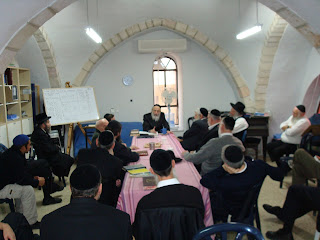 working for Rabbi Berel Wein-also great lover of k’lal Yisrael who has dedicated his life to teaching all Jews about their heritage. This position promises to be an exciting challenge, too. Those nine months between jobs afforded David the once in a lifetime opportunity to learn Torah full time. He loves learning at Yeshiva Rabbi Akiva, it is tailor made for him. Rabbi Gold is kind and serious, and understands both the limitations and aspirations of his talmidim. They work hard to earn their share in Torah.
Now it is bein hazmanim. Yeshivas have been on vacation since Rosh Chodesh Nisan, and this week the whole country is on vacation from work. Everyone is free. Free to be with family, free to travel this outrageously beautiful Land. But first, we cleaned and planned, purchased and prepared. We made our one, pure Seder.
In the Hagaddah, we said “...He took us out from there in order to bring us to Eretz Yisrael and to give us the land that He promised to our ancestors.” The ultimate purpose for which Hashem took us out of Egypt was to make us a nation, to give us His Torah and to bring us to the Land so that we can serve Him here. He did it in the blink of an eye-after centuries of suffering and yearning.
And miraculously, here we are. Our aliya anniversary lands squarely between Yom Ha’atzmaut, the day commemorating the miracle of the modern state of Israel and Yom Yerushalyim, the day of the miracle of a unified Jerusalem. Since we know that there are no coincidences, we’ve wondered about the message in this juxtaposition.
Jews began coming home en masse just 60 years ago. Untrained farmers and poorly armed fighters, with help from Above, built this country into a world economic power on a foundation of hope. It happened in the blink of an eye- after a long, dark disastrous decade...and Hashem’s promise to our forebears over 3,600 years ago. Then Jerusalem was given into our hands in 1967- in the blink of an eye-after 6 miraculous days and 2000 years of our longing.
Salvation comes in the blink of an eye. I thought of this over Chol haMoed when crowds came to pray at the Kotel at sunrise. While the night sky still hovered, we covered our eyes and said Shema, thousands of Jews together. Suddenly the black peeled away and revealed a sky turned that true Jerusalem blue. The Shema left us with clarity that, G-d who is merciful, is the true Judge, the same One who loves us.
Here we stand again –arab armies and world opinion a wall of ill will surrounding us. The only place to look is up. It may seem that we are alone in the black night, but dawn will soon break and we’ll then see that Hashem’s love and mercy have been surrounding us the whole time.
The great Chassidic rabbi, Rabbi Elimelech of Lizhensk says that in times of trouble we should talk of the miracles that Hashem performed in Egypt, and through this, He will continue to perform great miracles of salvation. At our Seder we talked about how the miracles of Pesach story are the paradigm for the future salvation. Those miracles will be even greater than we can imagine! We also said that even though it is a miracle that we are a distinct nation with the living Torah and our home is Israel, without the Bais haMikdash, the ultimate purpose of our nationhood and Torah are not realized. And so, our Seder here in the Old City of Jerusalem ended just like yours did: “l’shana haba b’Yerushalyim.”
May we merit to see the Almighty’s miracles. May we speak about them throughout the year, and may all of His children-in the blink of an eye- come home soon.
Love,
Renee and David ...
22 Nissan 5768
Isru Chag shel Pesach
April 27, 2008
Dear Friends and Family,
As the first year anniversary date of our aliya approaches we want to acknowledge our gratitude to Hashem for all He did to bring us here. For ten years we talked of living in Eretz Yisrael. It was our dream. Until the day David said that if we did not set a date to work towards, it would remain just a dream. So we looked at our life and set our date for three years into the future: May 7, 2007. We started to plan. Of course, G-d laughed.
Our aliya story is a megilla of hidden and revealed miracles.
December 2006. Five months before our projected aliya date, things were not coming into focus. David felt he could not responsibly leave his position until the company he worked with, could hire medical sales professionals. He was trapped. They had no present plan to make this hire and we had no parnassa plan for Israel. However, David said things could change in the blink of an eye, so we started filling out the Nefesh b’Nefesh paperwork.
By February it was time for us to renew our lease at the apartment we’d rented as part of our aliya plan, which had included selling our house. We had a decision to make. Renew for a year, six months or three? We calculated the costs to sign at a lower rent for year and break it when things hopefully fell into place. Would it be wiser to commit to staying 6 months at a bit higher rent? It was quite pricey to sign for three months, yet that would bring us almost exactly to May 7, the date we’d chosen three years earlier. It had seemed so, so far away then. Now May 7, 2007 would be here in the blink of an eye. We decided to show Hashem that we wanted to come and we meant it. We signed for three. If He wanted us, we’d be ready.
The next week, David was somewhere he’d not been in 3 years: home in the middle of the day during the workweek. He was between appointments and decided since he was closeby, that eating his packed lunch on a table at home was nicer than eating in his car. On that day at that time, his cellphone rang. It was Rabbi Solomon who wanted to know if he’d be interested in working for HaRosh Yeshiva Noach Weinberg, may he have a refuah sheleima. This amazing opportunity came in the blink of an eye-after 10 years of prayer and effort.
An interview in Jerusalem was arranged for mid-March. David and I both felt that this position with Aish was a long shot, besides he still had that commitment to the company he was with. But the chance to spend a week with Rav Noach, shlita, was worth the trip alone and if that was not working out, then maybe another opportunity would arise while he was there. Just a few days after he booked his flight, David came home in the middle of the day again. This time he had news: management had finally decided to put on a medical sales team! In the blink of an eye, he was free...and we were jobless as well as homeless.
The interview in Jerusalem at Aish headquarters lasted a week and after a few days, all thought it was a match made in heaven. The compensation they offered was considerably less than a US salary but plenty to live on here, and the position was irresistible because it would, number one: be an exciting employment of David’s talents and energies on behalf on k’lal Yisrael and number two: get us to Israel: start date may 20.
I began a serious apartment search. Before David left, I had posted our desire for a 3BR 2 BA apartment with A/C on yahoogroups, luach, and flathunting. David was going to work in just 8 weeks, we needed a place soon and we preferred to live in, or at least near the Old City. I spent hours combing real estate listings, emailing agents and calling potential landlords. Nothing. Then, in the blink of an eye, that very week David was in Jerusalem, an apartment suddenly appeared on luach.com. David looked at it immediately. It was the apartment of our dreams, and still is...less one bathroom.
After a gracious outpouring of kindness and well wishes from our Atlanta community and mesiras nefesh, self sacrifice by our family who had to say good bye, we flew New York to catch our free El Al flight on May 7, 2007. But without David’s passport. It had vanished, and we weren’t going over the ocean without it! It was a tense, trying two days in New York to obtain another passport and aliya visa. The overnight passport agent charged $500 for his services, miraculously, I had stashed exactly five $100 bills –for emergency-in the same envelope that I thought held both our passports. On the afternoon of May 9, we stood in the consulate lobby with the Israeli guard who cried with us when our aliya shaliach exited the elevator, brand new passport and visa in hand.
David’s tenure at Aish HaTorah lasted about as long as the blink of an eye: only 6 weeks—it was a wonderful experience but not a good fit. However, that job gave our aliya a practical basis and was very meaningful work, exactly what he needed at the time. A month ago, David began
 working for Rabbi Berel Wein-also great lover of k’lal Yisrael who has dedicated his life to teaching all Jews about their heritage. This position promises to be an exciting challenge, too. Those nine months between jobs afforded David the once in a lifetime opportunity to learn Torah full time. He loves learning at Yeshiva Rabbi Akiva, it is tailor made for him. Rabbi Gold is kind and serious, and understands both the limitations and aspirations of his talmidim. They work hard to earn their share in Torah.
Now it is bein hazmanim. Yeshivas have been on vacation since Rosh Chodesh Nisan, and this week the whole country is on vacation from work. Everyone is free. Free to be with family, free to travel this outrageously beautiful Land. But first, we cleaned and planned, purchased and prepared. We made our one, pure Seder.
In the Hagaddah, we said “...He took us out from there in order to bring us to Eretz Yisrael and to give us the land that He promised to our ancestors.” The ultimate purpose for which Hashem took us out of Egypt was to make us a nation, to give us His Torah and to bring us to the Land so that we can serve Him here. He did it in the blink of an eye-after centuries of suffering and yearning.
And miraculously, here we are. Our aliya anniversary lands squarely between Yom Ha’atzmaut, the day commemorating the miracle of the modern state of Israel and Yom Yerushalyim, the day of the miracle of a unified Jerusalem. Since we know that there are no coincidences, we’ve wondered about the message in this juxtaposition.
Jews began coming home en masse just 60 years ago. Untrained farmers and poorly armed fighters, with help from Above, built this country into a world economic power on a foundation of hope. It happened in the blink of an eye- after a long, dark disastrous decade...and Hashem’s promise to our forebears over 3,600 years ago. Then Jerusalem was given into our hands in 1967- in the blink of an eye-after 6 miraculous days and 2000 years of our longing.
Salvation comes in the blink of an eye. I thought of this over Chol haMoed when crowds came to
 pray at the Kotel at sunrise. While the night sky still hovered, we covered our eyes and said Shema, thousands of Jews together. Suddenly the black peeled away and revealed a sky turned that true Jerusalem blue. The Shema left us with clarity that, G-d who is merciful, is the true Judge, the same One who loves us.
Here we stand again –arab armies and world opinion a wall of ill will surrounding us. The only place to look is up. It may seem that we are alone in the black night, but dawn will soon break and we’ll then see that Hashem’s love and mercy have been surrounding us the whole time.
The great Chassidic rabbi, Rabbi Elimelech of Lizhensk says that in times of trouble we should talk of the miracles that Hashem performed in Egypt, and through this, He will continue to perform great miracles of salvation. At our Seder we talked about how the miracles of Pesach story are the paradigm for the future salvation. Those miracles will be even greater than we can imagine! We also said that even though it is a miracle that we are a distinct nation with the living Torah and our home is Israel, without the Bais haMikdash, the ultimate purpose of our nationhood and Torah are not realized. And so, our Seder here in the Old City of Jerusalem ended just like yours did: “l’shana haba b’Yerushalyim.”
May we merit to see the Almighty’s miracles. May we speak about them throughout the year, and may all of His children-in the blink of an eye- come home soon.
Love,
Renee and David ...
Subscribe to:
Posts (Atom)


 Posts
Posts


